
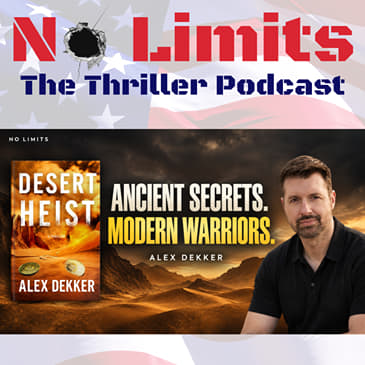
Author Alex Dekker joins No Limits: The Thriller Podcast for an author interview about his debut thriller, Desert Heist. A former special forces operator, Dekker discusses a story that blends ancient secrets and modern warriors, bringing together lost civilizations, special forces, and the intrigue of a heist. We explore the book’s mix of ancient mystery and modern-day action—and the imagination behind its premise.
—
🔗 WATCH, LISTEN, & FOLLOW US:
Website → https://thrillerpod.com
YouTube → https://thrillerpod.com/youtube
Spotify → https://thrillerpod.com/spotify
Apple Podcasts → https://www.thrillerpod.com/apple
Instagram → https://thrillerpod.com/instagram
Twitter/X → https://thrillerpod.com/twitter
Facebook → https://thrillerpod.com/facebook
💬 JOIN OUR BOOK CLUB
Die-hard thriller fan? Join our Book Club on Patreon for exclusive discussions, behind-the-scenes insights, and 24/7 thriller conversation:
👉 https://thrillerpod.com/bookclub
📚 ABOUT NO LIMITS:
• The Mitch Rapp Podcast: Deep dives into Vince Flynn & Kyle Mills' Mitch Rapp series.
• The Scot Harvath Podcast: Exploring Brad Thor's high-octane Scot Harvath universe.
• The Thriller Podcast: Book reviews across the thriller genre: Jack Carr, Dan Brown, and more!
—
#AlexDekker #DesertHeist #ThrillerPod #ThrillerBookReview
[00:00:09] All right, guys, welcome back to No Limits, The Thriller Podcast. Before I introduce our special guest, the man of the hour, let me tell you I'm with Crowley Clark, executive director of the podcast, filling in for co-host Chris. Crowley, thanks for doing this last minute for us. Crowley Clark Sure. Happy to fill in. Thanks for having me. Yeah, it'll be nice to have the perspective of a fellow author. Crowley just had his book Shadow of the Fathers published. And Alex, before we introduce you, Crowley was the one pushing me to pick up your book.
[00:00:39] And I will quote a text from him last week. Is Alex Dekker on your radar to interview? If not, you might want to talk to him. Let me know. His book just dropped. It's solid. Seems like an awesome dude. And he was at the Thriller Fest table with Jack Carr. So welcome, Alex Dekker. Tell us about Desert Heist and how the heck did you end up at that main event Thriller Fest table with the bigwigs? Well, thank you. It's great to be here. Thanks for having me. Crowley, thank you for the endorsement. Crowley Clark Sure.
[00:02:03] Crowley Clark Crowley Clark And how did you put together that with your personal passion for archaeology history? Is this something you knew you wanted to do for a while or did it just come to you? Alex Dekker No, not at all. So the thought of writing a book was not something that was on my radar. I spent 20 years in the Army, pretty much all of that in special operations. And so I had kind of a wall in between deployments where I'd been gone so long.
[00:02:29] Crowley Clark I basically got told to go home and do nothing for a little bit, which is not my strong suit. And so I needed something to do to occupy my time. And I just had this idea for a story. Crowley Clark You've mentioned a lot of things previously. You know, the mid-trapped series is kind of what I grew up on with thrillers. But Indiana Jones, Indiana, I've always loved Indiana Jones. It's always a small kid. So I saw, you know, Raiders of the Lost Ark. And so I've always loved that kind of high adventure.
[00:02:56] Crowley Clark And I've loved history. If I'm not, you know, as a hobby, I read history and go down historical rabbit holes and research these things. And so I got this idea for a story during that period, during that all 20 deployments. And I just thought, hey, this would be interesting to put it down on paper if there was almost an Indiana Jones type style adventure, but grounded in real history.
[00:03:20] Crowley Clark And the protagonist had a background that allows him to do these things and overcome a lot of these challenges that he had. And so, you know, I know special operations. I spent a career in it, but I love history. So I really just kind of melded the two together. And that's where Desert Heist came from. Crowley Clark So then, Alex, the empty corridor, I know Mike just mentioned, what was it about that region that made you say this is where Nate Wilde's journey begins?
[00:03:50] Crowley Clark So a couple of things. The legend of Ubar or Narama, the pillars is one that I've known about. I spent a lot of time in the Middle East. And so I think it's an interesting topic and it's one that's not widely explored. So that was fun to delve into. Crowley Clark I knew I wanted to be set in the Middle East anyhow. I spent the first half of my career at 5th Special Forces Group and our area of operation there is the Middle East. And so I spent a lot of time in the Middle East.
[00:04:17] Crowley Clark I'm a trained Arabic speaker. And so I knew I wanted to take place in that part of the world. Crowley Clark And then third is, you know, when you talk about these adventure type books and novels, it's really fun to go and explore kind of those undiscovered corners of the map.
[00:04:35] Crowley Clark And then third is, you know, the Rubalcali is one of those places. It's just, it's vast. It's kind of empty. And there's not a lot of traffic that goes on there. Crowley Clark It's one of those, when you go to these inhospitable regions, nobody wants to go do a lot of digging around and research and stuff. Crowley Clark So it's kind of a blank canvas for to set the story.
[00:05:04] Crowley Clark It's kind of, I always wonder about what the new frontier is, you know, what out there has not been tapped, not been touched, not been explored. Crowley Clark In the thriller verse lately, it feels like it's been China and Southeast Asia. Crowley Clark And what I think you really do is you keep us in a, I think, kind of a familiar setting for typical thrillers. Crowley Clark We've been reading, you know, GWAT thrillers, hundreds of them and reviewing them on the pod. Crowley Clark So we've always seen the stories in Iraq and Afghanistan and Syria.
[00:05:30] Crowley Clark But to go into Yemen and the Yemeni civil war and all this right on the border, I feel like that hasn't been tapped into as much. Crowley Clark And the fact that you're writing it in a modern day. Crowley Clark So it is post-war on terror. Crowley Clark That's debatable, but it is in this new modern climate. Crowley Clark And so what was it like having to write scenes, write battles, now that we're kind of removed from the typical Middle Eastern conflicts a little bit? Crowley Clark And also we're in Yemen, which has kind of been untapped.
[00:05:57] Crowley Clark Is that something that was exciting for you to write about or was it challenging? Crowley Clark It was exciting. Crowley Clark So as you say, we're kind of removed from the post-GWAT era is what we're in. Crowley Clark But the characters are also in their post-GWOT era. Crowley Clark And so it was kind of a nice parallel, I guess, in that we've sort of moved on from that timeframe and those conflicts. Crowley Clark And they have also moved on.
[00:06:24] Crowley Clark So they're finding themselves back into a region that they're familiar with where they have these experiences and they have to kind of confront some of those experiences. Crowley Clark So it really was a lot of fun to write and a lot of fun to write the two in parallel. Crowley Clark Yeah, and it's interesting. Crowley Clark You talked about that transition, writing a character who in some ways is out of the game, maybe at the peak, but still not active through various reasons and dealing with a lot of the trauma.
[00:06:52] Crowley Clark So it was a drama of, you know, being out early, like you said, having nothing to do between deployments, wondering if there will be a next deployment. Crowley Clark Probably not for him. Crowley Clark And that's where you pick us up. Crowley Clark So was that an intentional choice to have a character who wasn't, you know, like when we meet, you know, we're getting the backstory on a character or American assassin. Crowley Clark We go back and see Mitch Rapp's origins as a teenager, as a young guy. Crowley Clark Kind of.
[00:07:24] Crowley Clark Kind of. Crowley Clark So the thing for me is I think it'd be very difficult for me to write kind of a character at the height of their career in special operations or counterterrorism or something like that. Crowley Clark I've lived that life for so long, the thought of writing, it almost feels like work to me a little bit. Crowley Clark But to be able to take somebody who's doing those skills and has that skill set in that background and put them into this kind of historical mystery adventure, that's a lot of fun.
[00:07:52] Crowley Clark And so it's kind of a neat and interesting way to take that and then to plug it into something that I like and I'm passionate about. Crowley Clark I'm still very, very interested in. Crowley Clark The other thing is that we look at Nate Wilde and a lot of these other characters as well. Crowley Clark You know, you don't have to serve in the military to know somebody or heard the stories of how difficult it is when veterans get out and they try to transition, they try to move on, they try to go and find a new purpose in life. Crowley Clark That's typically the most challenging thing.
[00:08:22] Crowley Clark Everybody talks about how difficult it is to find a new purpose and how much they miss the camaraderie. Crowley Clark And so these characters, Nate and all the rest of the guys, they are confronting that. Crowley Clark It's maybe not what they thought it was going to be. Crowley Clark And so there are various reasons for all of them that sort of pull them back together and pull them back into this adventure. Crowley Clark And that also feels familiar because it's kind of a common thread in all the thrillers, the typical ones we read.
[00:08:47] Crowley Clark You got that team, the team of guys, you feel like you're with them, you know, you go through hell with them. Crowley Clark And that really came through in your book with just these four, you know, awesome characters, the ribbon that they're giving each other and, you know, being in the shit together. Crowley Clark And throw in the girl, right? Crowley Clark Got to throw in the girl. Crowley Clark Well, thank you. Crowley Clark I'm glad it came through. Crowley Clark That was one of the easiest parts to write only because I spent so long on these teams that, you know, a team really develops its own personality.
[00:09:13] Crowley Clark And so the interactions, the banter, everything else back and forth, that's a daily occurrence. Crowley Clark And so writing how these guys would talk to each other or react to each other is just, it's very natural. Crowley Clark This is as natural as you would write, you know, how you grew up with your siblings or things like that. Crowley Clark Sure.
[00:09:35] Crowley Clark One thing I really liked, Alex, was, you know, you have those Hollywood tropes of that loud kind of rogue operator. Crowley Clark And what I thought you did a really good job of is exploring that team's cooperation, the trust, kind of that quiet competence. Crowley Clark It just felt really real to me.
[00:09:55] And if you think back of your time in the fifth special forces group, what's that biggest myth about elite operators that you wanted to kind of dismantle in the book here? Crowley Clark Sure. So I think the biggest myth is kind of that lone operator hero who does it all, so to speak, that the Rambo-like character. And they're not to say that, you know, a singular Green Beret or a singular Navy SEAL or whatever it might be is not a dangerous individual who's very capable.
[00:10:25] Crowley Clark But I think a lot of times what we tend to see is just the one man show. Crowley Clark He can do it all. He can, you know, solve a complex problem. Crowley Clark You can put, you know, build an explosive charge. Crowley Clark You can fly a plane, whatever it is it needs to do. Crowley Clark He can do all of these things. Crowley Clark And I wish that everybody was that cool, but that's not generally the norm. Crowley Clark The reality of most special operations units is the strength comes from the team.
[00:10:51] Crowley Clark And so where you have somebody who's strong in one area, maybe weaker in another, somebody else compensates for that. Crowley Clark And so you see some of that in the book where Nate's a Green Beret. Crowley Clark He's handy in a firefight and he can handle himself in a, you know, a fist fighter or whatever it might be. Crowley Clark But he's not, he's not, he's not, he's not Shane Price. Crowley Clark You know, he's not going to win everything all the time. Crowley Clark He also may doesn't have the connections. Crowley Clark He can't, he's not as resourceful.
[00:11:18] Crowley Clark Maybe he doesn't know things about these weapons as much or whatever it might be. Crowley Clark And so medical skills, right, as a base level, if you would cross training. Crowley Clark But, you know, I was never a, I'm an 18 Delta special forces medical sergeant. Crowley Clark Those guys are on a completely different level that can do things that I could never hope to do. Crowley Clark And so these guys all kind of, they balance each other out and wherever they're weak in one area, they compensate. Crowley Clark And that's really the truth of most special operations units is exactly that.
[00:11:48] Crowley Clark Strength comes from the team. Crowley Clark That's great. Crowley Clark Yeah, there's two other really important characters in Nate's life. Crowley Clark And it's these adoptive or adopted like almost his mentors, the elderly couple. Crowley Clark And I got to say that felt like some of the most heartfelt writing that you put on the page, some of the deepest connections, almost like the family we choose, right? Crowley Clark How he sought out and they sought out him and, you know, in this program to help veterans.
[00:12:15] Crowley Clark And to me, that just felt so real and visceral. Crowley Clark Is that another element you wanted to bring of just having that anchor, you know, behind you, guiding you the right way? Crowley Clark And they don't only guide him in his decisions post military, but they guide him in the academic career and the academic world that he's pursuing as well. Crowley Clark And he might have not made the choices he made without having them in his life. Crowley Clark I thought that was a very heartfelt scene that you wrote. Crowley Clark Thank you. Crowley Clark For sure. Crowley Clark I wanted that to be in there.
[00:12:44] Crowley Clark A lot of people in the special operations community that come from challenging backgrounds, challenging childhoods, I guess it's kind of like a common theme that you see and Nate is very much no different. Crowley Clark But it is important to have people in your life that guide you. Crowley Clark And so Nate has kind of these surrogate parents, right?
[00:13:06] Crowley Clark He has some challenges with his own father and things like that, which, you know, setting up the world for future things. Crowley Clark But it was important that he had kind of this, I don't want to say guiding light, but someone to help steer him onto a path. Crowley Clark Because the reality is that no one does it alone. Crowley Clark Everybody has generally a mentor or guidance of some sort. Crowley Clark That's what he needed to have. Crowley Clark That's really the part of those two.
[00:13:36] Crowley Clark That also helped him through a difficult time, I would imagine. Crowley Clark It really struck with me and I don't want to give away everything about the scene, but there was a scene when, you know, imagine everything a warrior has been through. Crowley Clark And you come home and whatever your next step is and for him it's getting into the academic world, busting into archaeology, getting his degree, pursuing that PhD. Crowley Clark And all of a sudden you're told no, the door shut. Crowley Clark And everything you've been doing and all the work you've been putting in is rejected. Crowley Clark And you have to fight against that.
[00:14:04] Crowley Clark Was writing about the struggles of entering academia, which itself has its own code and gatekeeping and secret, you know, pass codes you have to know. Crowley Clark Was that something came natural to you? Crowley Clark You seem very scholarly, but almost in a, like me or Crowley or any of other like nerds geeking out about history just on the internet YouTube channels. Crowley Clark Do you also have a formal academic background, either in archaeology or other subjects? Crowley Clark Not in history.
[00:14:30] Crowley Clark So as I was writing some of that, I was working at going through Georgetown for my master's in intelligence. Crowley Clark And so a little bit of that flavor of the academic world and some of those challenges. Crowley Clark Whenever you come at it a little bit later in life or, you know, with a little more experience in a certain realm, Crowley Clark You'll get a different differently than you would maybe a little bit younger going for undergrad or things like that.
[00:14:56] Crowley Clark So I think some of that probably bleeds through under the pages. Crowley Clark And then, you know, but I don't have a PhD in archaeology. Crowley Clark And so I was able to talk to a couple of different archaeologists that do. Crowley Clark And, you know, I talked to them not only about what their careers have been like and their excavations and their time on dig sites and kind of their methodologies and things like that.
[00:15:22] Crowley Clark But I talked to them about like their academic path and what that was like going for their, doing their dissertation, going to get their degree. Crowley Clark Just kind of capture some of those elements, some of the, some of the more challenging parts, some of the, some of the frustrations, things like that. Crowley Clark And so it was, it was very interesting to talk to them and hear their perspective. Crowley Clark And definitely very informative so that I could help kind of channel that into the book as well.
[00:15:47] Crowley Clark Speaking of the archaeology of it all, let's get into Ubar. Crowley Clark Can you tell us about this mythical lost civilization? Crowley Clark I love the description in the book, the Atlantis of the desert. Crowley Clark And right there on the cover, you capture it so well with the different wadis and channels and archaeological features and even the coin, the coin itself. So tell us, you know, soup to nuts. How did you come up with this whole mythology of the Atlantis of the desert?
[00:16:16] Crowley Clark So it's something that, like I said, it's something I heard about kind of like Nate a long, a long time ago. Crowley Clark And so I've been kind of aware of its presence. And so I knew that there was probably need to be an objective for Nate to get to and then falling into the Middle East and all that just kind of made sense. Crowley Clark And so Ubar, Arama the Pillars, Atlantis of the Sands has all kinds of different names.
[00:16:42] Crowley Clark It's fascinating because it's one of those things. People tend to know a little bit more about like South America, right? Crowley Clark You're El Dorado and Cibola and all of these kind of things, the lost cities, Percy Fawcett and Francisco Orion, all these guys searching for these lost cities. Crowley Clark What's less known is about Ubar, which had, you know, Harry St. John Philby, right?
[00:17:07] Crowley Clark Bertram Thomas, T.E. Lawrence was interested in searching for the city and just died before he got a chance to do so. Crowley Clark And then there was an expedition in the 90s, I think 92, where they went looking for it and found a city down in Oman that they said could have been it. Crowley Clark And so there's been a lot of interest in searching for the city. You just don't hear as much about it. Crowley Clark And there's, of course, there's the oral traditions that you hear, you know, from the cultures out there, from the Bedouins, from the tribes there to talk about these stories.
[00:17:36] Crowley Clark It does show up in the Quran. It's mentioned, it's mentioned in 1001 Nights. And so there is this, I don't want to say necessarily evidence, but there is, you know, a body of work that points towards the existence of this lost city.
[00:17:52] Crowley Clark And it discusses it not as a, not necessarily as an allegory or anything like that. It's as a city that was real that existed. It was this, this, this city, it was a way station on the old frankincense trade routes, the old incense trade routes. Crowley Clark And because of where it was located and the, and the, the amount of traffic that passed through, it got enormously wealthy. It got greedy, it got decadent. This is kind of a story that you hear in a lot of different cultures.
[00:18:20] Crowley Clark And so, you know, the, the, the ruler Shaddad is building these great giant structures and just very, very decadent. You know, the Lord sends a prophet HUD to go warn them to kind of repent and change their ways. They refuse. Crowley Clark And so he smites the city from above and it sinks below the sands. That's kind of the, that's kind of the, the, the legend of it.
[00:18:45] Crowley Clark What's interesting is that there are all these different aspects to it, such as Saudi Arabia is one of the great, is a great place for meteors. Crowley Clark And to, to examine those, there's the Waybar craters. Those are real, they exist. There's been at least a couple of documented cases of, of large scale impacts out there in the desert. Crowley Clark And so it all kind of ties together enough that it is, it is believable to the point where I was actually building it out.
[00:19:12] Crowley Clark Because it was a lot of fun to actually build out the, the mystery that Nate was trying to solve. Crowley Clark I had to stop and think to myself, like, could this be real? Is this out there? I don't know. Crowley Clark There's, there's a lot of evidence and it's certainly worth, certainly worth the question and worth exploring. Crowley Clark Your process reminds me exactly of like reading a Cotton Malone book. Crowley Clark I don't know. Are you into the Steve Barry Cotton Malone books at all? Crowley Clark Yes.
[00:19:34] Crowley Clark He takes a time period like that. We have these nuggets, we have these stories, we have quite a bit of evidence that points towards something, but a lot of it just becomes folklore. Crowley Clark And, and he builds that up and puts it with a, the modern shoot them up style thriller combines the two perfectly. Crowley Clark I was really thinking about him reading this book. Crowley Clark Yeah, for sure. I mean, there's these great, Steve Barry, Clive Cussler. Crowley Clark Sure. Crowley Clark Who I started reading early on, like my, my first deployment ever. I think I kind of got in Clive Cussler.
[00:20:03] Crowley Clark Dan Brown, obviously. You know, I can remember, I can remember reading Da Vinci Code along with everybody else in the world. And, you know, I'm reading it and I having trouble distinguishing where the facts stop and the fiction start. I thought that was so cool. Crowley Clark That, you know, if you pull on those threads, they go back to something that's, that's real and true. And so I wanted Desert Heist used to be the same way. I wanted there to be so much historical fact that it's difficult to tell what's true, what's not.
[00:20:29] Crowley Clark And if you, you know, if you hear something about, uh, Bartram Thomas out in the desert or whatever it might be, uh, T.E. Lawrence wanted to use airships to go look for the, like, is that real? And if you do a quick Google search, you'll find out that it is real. And it, it does trace back to something. So it's like, it's, it's a lot of fun when you can do that and, and kind of build, build out the larger narrative from all that, that fact. Crowley Clark Yeah, I'm a sucker for that. So you got me. You got me on that one.
[00:20:56] Crowley Clark And it's a double for me because I love doing historical research. I do this anyway for fun. I'd, Crowley Clark I have, you know, a dozen browser tabs open at any point in time, just researching random historical facts and rabbit holes. So now I get to incorporate it into writing. Crowley Clark And your archive scene. I remember doing that in college. I was a history major and, uh, you know, going into, uh, the archives here in DC. I know, I know you, uh, said Georgetown before. So I'm actually, uh, right here in Northern Virginia.
[00:21:20] Crowley Clark But yeah, I remember going through all the libraries, all the archives, the GW libraries and just sitting there. Not, I never got the white gloves, but, um, I definitely had to sign out some documents, sit in a room. Crowley Clark There's a camera monitoring you almost felt like, you know, they were hooking me up to a lie detector test or something just to go through the archives. Crowley Clark Yeah. I liked how you wrote those scenes. Crowley Clark Again, it's just, just part of that authenticity. Um,
[00:21:42] Crowley Clark You know, it's what you want. I mean, you hear it talked about a lot with, um, action, right? You know, you don't want, uh, what's the, uh, safety on the Glock, I think is the kind of the common one that's talked about. Crowley Clark You know, you don't want people to be taken out because of the action or something gets wrong. And, um, I'm pretty good on that, on that part just from my background. Crowley Clark But, um, for some of the other stuff, it's, you don't want someone who, and I've had a couple different people I've talked to that are, um, historians or archaeologists that enjoyed the book and said,
[00:22:11] Crowley Clark Hey, I like how you got this right. You know, um, I don't want them taken out of the story either because I got something wrong that is maybe not necessarily my, my professional wheelhouse. So, you know, doing, doing the research and doing the due diligence, uh, that's pretty important. Crowley Clark It does sound like that would overlap though with your mission in a fifth group and special forces because a lot of that would be that human to human contact where, uh, the sources and the Westerners, you know, describing something in the secondary text or writing it down in a journal
[00:22:39] Crowley Clark Might not be as authentic as the conversations you have with the indigenous peoples, like you said, the Bedouin tribes. So would you say that was something you were also trained on either in the military or your Georgetown degree that this kind of human side of things of sifting through the garbage, really listening to the voices who have authority or who have tradition on their side and valuing that as opposed to a world that really only values, you know, the clicks or the headlines. Crowley Clark It's like, no, sometimes we have to listen to the quieter voices embedded in the culture and that's where we find the gold.
[00:23:10] Crowley Clark Absolutely. Crowley Clark Absolutely. Crowley Clark I mean, I have a fair amount of training and experience in, in, in that realm as well. And, um, I think that when we talk about, so like Nate Wilde's background, he's a Green Beret. Crowley Clark A lot of people don't necessarily, um, know exactly what a Green Beret is, but the, the core mission set of Army Special Forces is unconventional warfare.
[00:23:32] And it's essentially, um, working alongside an indigenous partner force, um, in a denied area to, to coerce, disrupt or overthrow an occupying power. Crowley Clark And so, um, a lot of that, whether it's Vietnam in the mountain yards or, um, you know, Afghanistan with the Northern Alliance or Iraq with, uh, the Iraqi Special Operations. Crowley Clark And then, you know, later Afghanistan with Afghan military commandos or their units, uh, Syria with, with rebel groups.
[00:24:01] Crowley Clark It's, you, the, the idea is you go work with those indigenous people. Crowley Clark You help, uh, kind of train them up and employ them and then lead them kind of into victory against whatever this oppressive regime. Crowley Clark And so, uh, it is a lot of embedding with the culture. Crowley Clark It's why we learn languages. Crowley Clark It's why, um, you know, we, we, we, we train in, in, uh, in culture and we, we, we focus so hard on that aspect.
[00:24:27] Crowley Clark It's also why the, the Special Forces groups are regionally aligned so that you can kind of develop an expertise in that, that region of the world. Crowley Clark And so, yeah, it's pretty important. Crowley Clark There's a lot of similarities between that and say being an anthropologist where, uh, it's, you know, you're doing the same kind of thing. Crowley Clark So, so, so Nate combines both of those into, uh, into one and each one kind of makes him better at the other, so to speak. Crowley Clark Yeah.
[00:24:56] Crowley Clark That's certainly a recipe for crafting a character that's different, that stands out because we've had so much of the SEALs, uh, lately that seemed, we, we seem to have a boom, you know, in the, in the early two thousands or the last two decades, really. Crowley Clark It was kind of the SEAL boom. Crowley Clark And I feel like there's so much more to the special operations community and even the intelligence community. Crowley Clark We've, we've always been so focused on CIA in so many books, but man, look at all the other, what you can probably speak to it. Crowley Clark How is it? Crowley Clark How is it? Crowley Clark How is it? Crowley Clark How is it? Crowley Clark How is it? Crowley Clark A lot of the geospatial stuff. Crowley Clark Yeah.
[00:25:26] Crowley Clark I feel like GIS, uh, we have a little bit of coordinates and a mapping in here. Crowley Clark Did you ever get your hands on with GIS and a lot of that and some of that creative mapping, the way we're looking at the hydrology maps and, and, and the aquifers. Crowley Clark I feel like a lot of new technology can support the missions that you're talking about. Crowley Clark I've had many, uh, many long nights with ArcGIS and a lot of those other programs for sure. Crowley Clark Yeah. Crowley Clark And you're right.
[00:25:52] Crowley Clark The, the, the SEALs have, uh, had done a masterful job at marketing over the last like two or three decades. Crowley Clark It's great. Crowley Clark You see it in, in, in, in fiction and nonfiction, um, which is where you, back in the day, people think knew a little more about Green Berets or, you know, you had, you had Rambo, you had the A team, you had some of these other things. Crowley Clark Then with the global war on terrorism, that kind of fell away and SEALs wrote to the forefront and you're in, you're right. Crowley Clark You see a lot of SEAL protagonists and things now.
[00:26:18] Crowley Clark And so, um, it's kind of fun to, to bring the, the unofficial tagline, I guess, of Green Berets is the quiet professionals. Crowley Clark So the idea is that you, you, you don't talk a lot about yourself. Crowley Clark You don't talk a lot about what you do. Crowley Clark And so it's fun. Crowley Clark Now that I'm out and then I'm retired and I'm out of the military and I'm kind of writing a book where my protagonist,
[00:26:39] Crowley Clark And so, um, you really do reach out and touch people in ways that stick with them.
[00:27:07] Crowley Clark As they, as they, they learn and grow through fiction. Crowley Clark And so it's fun to put Green Berets kind of mainstreamed back into fiction a little bit. Crowley Clark And, uh, you know, who knows? Crowley Clark Maybe there's some 18, 19, 20 year old kids that are reading the book that might say, hey, you know, Crowley Clark You're in a Green Beret sounds pretty cool. Crowley Clark And then, and then the regiment gets, uh, some new, uh, highly qualified recruits, hopefully. Crowley Clark So you never know. Crowley Clark Sure. Crowley Clark Yeah. Crowley Clark So one of the things I was thinking about,
[00:27:37] Crowley Clark You guys are talking about this balance of, of Nate's character, right? Crowley Clark He's this guy who was in combat. Crowley Clark He's an academic. Crowley Clark I won't get into spoilers yet, but the, the tactical choices and the final chapters lead to some pretty heavy consequences for the team. Crowley Clark As a combat veteran and an author, how hard was it to balance that kind of whimsical Indiana Jones sense of discovery with the,
[00:28:06] Crowley Clark The brutal realities that come with actual military operations? Crowley Clark Not as difficult as you would think. Crowley Clark It's almost kind of like a, it, it's a license to do both, I guess, in a certain way. Crowley Clark So while I wanted the, the, the, the action in it to be real, real enough that it, that it makes sense and it's grounded and real tactics and real things could happen. Crowley Clark It's not fanciful. Crowley Clark It's not over the top.
[00:28:36] Crowley Clark So what that does is kind of opens it up and allows it for some of the other elements to, to be, to maybe suspend a little bit of belief, right? Crowley Clark Because you have to, for, for a good story and for a good adventure story, especially if you're going after historical mysteries and things like that. Crowley Clark And there's a world you have to build and then you have to, you have to take to the point where, okay, I need to suspend a little bit of belief to, to, to go on this adventure. Crowley Clark What I didn't want was for any of the action to go that way.
[00:29:01] Crowley Clark And so, um, and that's why a lot of the things that occur, I'm trying to talk around spoilers as well. Crowley Clark A lot of the things that occur are, um, uh, grounded in things that are, that are real, that if you're, if you're reading it, um, there's probably, there's probably people out there that found themselves in similar circumstances or experiences, right? Crowley Clark The, the, the parts in the book are not necessarily real things that happened. Crowley Clark And they are influenced by, um, some different experiences that I've had.
[00:29:30] Crowley Clark And so I'm able to channel that into, into the, the words that eventually make their way on the page. Crowley Clark So we're dancing around it. Crowley Clark Can we jump into spoilers? Crowley Clark We can put the spoiler warning in here because Crowley Clark You're sure. Crowley Clark You tell me. Crowley Clark That final culminating action scene, there's going to be, there's gonna be a lot of fallout to deal with that Nate's going to have to deal with and, um, what the team suffers. Crowley Clark So maybe just give us a little hint. Crowley Clark Where's Nate at, at the end of this book? Crowley Clark Why'd, why'd you intentionally do that?
[00:29:58] Crowley Clark And you have more adventures planned for him. Crowley Clark We already heard other books are in the works. Crowley Clark So how are we going to transition from, from here to there, if you will? Crowley Clark Well, so that's the fun of it. Crowley Clark So where were your fish land spoilers? Crowley Clark Yes. Crowley Clark Spoiler alert has sounded. Crowley Clark I'll insert that in. Crowley Clark Yeah. Crowley Clark At the end, at the end, they, they find the city. Crowley Clark And, uh, Shane kind of pays a little bit of a price for it.
[00:30:26] Crowley Clark But it, it kind of works out, right? Crowley Clark It kind of works out in Nate's favor and he gets a lot of things that he wanted or so he thinks, right? Crowley Clark So like we talked about before finding that sense of purpose. Crowley Clark There's an interesting concept with, um, with a lot of veterans, a lot of special operators, uh, especially, um, which is this, this idea of peace and chaos.
[00:30:52] Crowley Clark And so what tends to happen is you spend so long in, uh, these chaotic environments, right? So you're training for them, you're deploying in them, you're doing all these things. So that chaos becomes your new baseline. So when you're now in the peaceful parts, that becomes uncomfortable and you find yourself drawn back to the chaos a little bit. Crowley Clark Nate is no different. Nate may have some things going on, right? Nate is suffering a little bit from some things that he experienced. Crowley Clark Nate thinks he's okay. Nate's not okay.
[00:31:21] And that's, that's kind of something that he's exploring throughout the book. Um, he doesn't understand this aspect of it either. He thinks that, okay, so it's great. I found this lost city and I'm going to get the chance to, uh, to dig into it and kind of see what history is out there. Like I've won, I've gotten what I want. Um, maybe, maybe that is what he wants. Maybe it's not, maybe it's not what he needs. Um, half of the fun is okay. Well, how do you now drag him and some of these other guys into another scenario?
[00:31:50] That's not just another trope or just another, um, you know, how do you, how do you make it interesting and believable and something that would, would get them out of their comfort zones back into this environment. And so, um, I think I've, I've done that with book two. Um, I, I've just gotten my edits back mentally best where so I've been working on the edits for book two. Now I'm in the process of writing book three. I've done it in a much different, unique way and a little bit of a different direction for book three.
[00:32:18] I have these things planned out for, um, I don't know, I think probably to like book 15. Um, and so it's just, it's, it's, they're, they're just so fun, but it's also, I don't want to say they write themselves, but I see where it goes as I write it. Like I understand where the trajectory is going to be. Um, which is also a lot of fun because if I know what's going to happen in book six, I
[00:32:41] can seed things in books one, two, and three that, um, you'll, you'll read or have read and, um, they're interesting, but you don't understand the significance of them until book six. And then go back and look, you realize what that was all about. So it's a lot of fun just to build this, this big, great world that, uh, that Nate gets to discover and the readers get to discover at the same time. Now I hear you have this outline for so many books ahead, but on the day to day minutia of writing, would you still consider yourself a plotter?
[00:33:10] Is, is your outline that detailed or is it just the general broad strokes that, that Nate and the story will go through? Or are you still more of a pants or you, you're just, you're just letting the story unfold as you write in the moment. Yeah. So I think like a lot of, a lot of authors, a lot of writers, I'm a combination. But my outlines are very thin. I mean, it's okay. You're talking like a sentence or a bullet point kind of sectionally about what happens and I'm constantly, you know, the, the gears are constantly turning as we kind of think
[00:33:39] around, I'll think up something or I'll read something like, Oh, that's good. That goes here. You know, keep a running, running notes list or whatever it might be. Um, but the, the outlines are very thin. It's, I know, I know where it begins. I know where I want it to end. And I kind of know what that trajectory looks like. Um, and some of the key pieces when I sit down to write, it's very much a pantser and that the story unfolds and takes you places. You probably didn't even know it was going to go, uh, which is also a lot of fun.
[00:34:06] One thing I thought you did a really good job of is taking the, I would say like that, that idea of the ancient artifacts and more of that Indiana Jones feel, but really bringing it in with this, um, more 21st century struggle over those critical natural resources. So I wanted to wait on this question because I didn't want to, to give too much in the
[00:34:32] way of spoilers, but can you talk a little bit about how you put that together with the, uh, with the water and, um, the, the more, uh, ancient adventure and tied together so well. Yeah. So, uh, so Nate has his objectives, right? For him, it's, uh, he's, he's looking for this lost city and it's about his, his dissertation. And then there's also some of his underlying themes about kind of, you know, that, that
[00:35:02] brotherhood reclaimed and, and kind of finding himself a little bit. Um, and so that's, that's kind of, that's, that's for Nate. What Nate doesn't know is he's part of something much larger and much broader. Um, and so it's kind of fun to do again, that, that kind of in parallel where, you know, you ask yourself, well, this is, this is great. This, this is, this is Nate's personal odyssey. Um, what are the, what are the higher stakes? Well, the higher stakes are that Nate's playing a game he doesn't even know, um, his, his
[00:35:31] opponent does. And so, uh, throughout the book, there's these, these interactions. He doesn't know who they are or why it is or why he's, he's kind of being hunted in this way, um, until he eventually finds out. But obviously, um, you know, the antagonist does. And so it was, it was a lot of fun to have the, cause it's, it's always great to have something that's a little bit higher stakes, right? Maybe a little bit geopolitical or, or, or whatever that might be.
[00:35:59] It was a lot of fun to have that section of it. Um, where Nate doesn't even know that's, that's occurring. Um, as far as it being the, the water versus oil, that's, um, yeah, when you look at the, the, the impending water crisis that's going on in many places and including Saudi Arabia is one of them. Um, it's interesting because it's, you know, surrounded by water. Um, there's a lot of water underneath and it's a matter of how much and how do you tap into it or how do you purify it? All of these kinds of questions.
[00:36:26] And that's things that the, the, the, the kingdom will have to figure out and do so in recent years, whatever you consider the per capita water use that Saudi Arabia has. Um, and so what they do have is an, uh, an abundance of oil, which is what everybody wants. And so if you're an outside oil company, you don't care about water. You don't care about what that matters for them. And if you were to accidentally discover something like large, you know, a large reservoir of water that can help change kind of the face of the desert, you'd probably want to keep that
[00:36:55] hidden and look out for your own injury. So, um, it, it, the, it's one of those things where, um, the, the, the, the, the terrain and the geopolitical landscape kind of almost build that problem set for you. You just have to read it and, and make it interesting. And you built a conspiracy around that touched on a little bit of these global elites controlling resources, you know, playing these, these dark games to keep their interests, uh, fortified.
[00:37:24] Is that something you foresee as a future tent, the tentacles of that as a future villain? Do you have other, other ideas that you could bring in as a villain or do you really think this conspiracy, uh, is deeper, uh, than we first thought? I think that you'll probably see some of that crop up down the road. Um, yeah, I was thinking of Spectre the whole time. Yeah. Yeah. It's so, okay. So, uh, yeah, I don't want to give away too much for now.
[00:37:51] We're talking like future, future spoilers, but, um, you know, when you look at one of these, if you, if you talk about kind of this, uh, this, this global cabal of whatever that's controlling things, um, you gotta keep in mind the, uh, kind of the theme of desert heist and kind of the, the Nate wild universe, right? Which is ancient history. So how do you combine those two to make it something that's fun and interesting and something that we haven't seen before?
[00:38:18] Um, I, I, that's, that's, that's, that's. That's gotta be a challenge though, because like Crowley said, the way you combined, here we go. Like I was thinking in this book, like how do you put together a beauty pageant winner, uh, hydrologist and making exciting when she runs into an amateur archeologist in the middle of the empty corner, I'm like, yet you were able to take something so, you know, that it seems so, so like a minor, it seems like these people, like what role could they play?
[00:38:48] And now they're up against this global conspiracy. I feel like to find those perfect end, an ancient city to put together the perfect blend of history, modern geopolitics, and these kind of very obscure interests for archeology, hydrology to put that all together. So masterfully, it seems like this plot was just genius. And you plan to repeat that. Uh, can we pre-order the book now? Can we pre-order number two, three and 15 all at once? Well, thank you.
[00:39:15] Uh, it's open for pre-orders yet, but, uh, let's get David on it. Yeah. We never loop back to that actually. So I mentioned thriller fest and you're, you're up there hobnob and with the Jack cars of the world and you, your book on front of Emily Bessler. Can you tell us just a little bit of that process of how you rightfully got rewarded for working so hard on this thing and you shot to the top? So, yeah.
[00:39:43] So I, uh, I'm very, very fortunate, uh, and very grateful for it. I, um, like I said, I wrote desert heist and I put it away and didn't really think about it again. Um, and I didn't have any intention to send it anywhere. I just, I really, I wrote it for me and I wrote the second one for me and I was going to kind of keep writing them for me as kind of like a, a hobby project.
[00:40:06] Um, and it wasn't until I met my now wife who, um, she's a former CIA operations officer. We met overseas. Um, and during the course of our, our courtship, it came up that I, I'd kind of written a story and so she asked to read it and I very hesitantly let her read it. Um, and she was like, this is really good. You have something here. You should, you should do something with it. And so I kind of let some guys in my unit read it.
[00:40:33] Um, got some positive feedback there and so, okay, what, maybe I should do something with it. And so I kind of looked at the process and learned about literary agents and query letters and all of that. And I sent some out and I got back some interest. And one of the interests, um, was, uh, my agent now, um, Alexandra, who was basically she said, I love it. Let's do it. Um, I have an idea of somebody I want to send it to, but it needs to be at the right time. And, uh, this is, this is a, a great story. I've told the story a couple of times on a couple of different interviews, but
[00:41:04] it, uh, she got back to me on my honeymoon in Hawaii, um, and called me at, I forget whatever time it was and was like, Hey, uh, Emily Bessler loves your book. Um, can you do a zoom call in 10 minutes? And so I'm, I'm in a hotel room in Hawaii and I'm frantically running around trying to find like the nice shirt that I brought to Hawaii to do zoom call. Um, and I talked to Emily for an hour. She's obviously a wonderful, brilliant woman. Um, had a great conversation.
[00:41:34] A couple minutes later, my agent called me and said, uh, she wants to do it. And let's, let's go from there. And so, which kind of, kind of took off from there. Um, fast forward a little bit. Uh, I was in, uh, uh, Mallorca actually. Um, again, with my now, now wife and, um, I got a call from my agent who said, Hey, um, Roland white from, uh, Michael Joseph of penguin random house, UK imprint.
[00:42:03] Um, read your book. What can you do a phone call in 10 minutes? And so I, uh, I talked to him and so they have a, uh, you know, it, it also like two days after it was released at the, uh, the UK version came out as well and a lot of different territories. And so, um, the running joke is that we need to keep traveling and going on these vacations, right. Keep getting these great phone calls. Um, but that was, that was kind of the process. And so from there it was just kind of off to the races and, um, that's really it. Wow.
[00:42:34] So follow up question to that. If you could do it over, focus on that first book. What did you learn writing, editing, getting published, going through what you have so far with the book launch that you'd do differently if you had the opportunity to start over from the point of just the finished manuscript? Hmm. That's a great point. Or would you do anything different? Probably not. Honestly.
[00:43:03] Um, I think there, there's a, there's a certain strength of not knowing what you're doing. Um, to not understanding what the process is, what's normal and what's not. And so I would, I had people down the road tell me like, this is not necessarily the normal process or it's not usually like this. Usually you, um, have some, some different hoops to jump through or whatever, but, but not knowing that and just kind of pushing and, and, and, and going, um, you know, full tilt as much as you can. Um, I'm very pleased with the results.
[00:43:31] Like I said, I'm very, very fortunate in, in how it all, um, unfolded and how it, how it all happened. And that's even, even as far as, um, you know, the, the writing community is amazing, which I did not expect. I don't know what I expected, but, um, as I went to thriller fests and, um, aside from the awards banquet, um, I got to go to a lot of the different stuff. I got an opportunity to be on a panel to kind of talk about my, my publishing process, but everybody I met who, no matter who they were, what stage they were at was just so, uh, great
[00:44:01] and warm and inviting and welcoming. And it was just, it was, it was so nice to see, you know, especially transitioning from the military, which is a scary transition, right? Um, so it's, it's a big transition, um, to kind of jump off into this realm. It was just amazing to see. And that goes for a lot of these, these top notch guys. I mean, I reached out to some of these guys. We talked about Steve Barry. I reached out to Steve Barry and said, Hey, would you be interested in reading the, my book? And if you like it, you know, uh, let me hear your thoughts. Um, he said, yes.
[00:44:30] And he wrote back and said, it's great book. I loved it. You know, here's a, here's a blurb for you. I mean, I read Steve Barry, you know, for, for years. I, uh, who would think that, uh, you know, David McCloskey, um, Simon Gervais, uh, all these guys were just so, uh, Brad Taylor, just so nice. So welcoming. So I just, it, um, it was really great. It was really great experience. And, um, it's really nice to, to, to leave one community that I really enjoy and, and,
[00:44:58] and work with a lot of great people into one where I'm surrounded by more great people at all different stages and all different walks and all different formats of the publishing process. Wow. Moral, moral of the story, guys, find yourself a girl who's willing to read your thriller. That's true. I mean, yeah, I, I recommended a Mitch Rapp book to my wife once. I think she made it through 20 pages. It was like, it's just not for me. I'm like, all right, well don't ever listen to my podcast then.
[00:45:30] You know, there's a lot of these guys, um, that there's so many guys that do it so well, right? Um, these, these thrillers, obviously the, the, the Vince Flynn series and the Vince Flynn estate now and the guys that are writing it, Brad Thor, Jack Carr, Mark Greeney, all of these guys, um, they write, they write so well and they do it so well. There was a point, um, where I really, I stopped reading this stuff cause you know, just my, my, my day-to-day job, I didn't reading it to unwind was not, it was, they, they wrote,
[00:45:59] they write too well and they write too realistic. And that's the highest compliment I can pay on where there was a period of time where I can't read this stuff to relax. And then as I kind of like weaned out and found my way out of the army, I was able to start enjoying these books again. But, uh, so many of these guys just do it so well. Um, and I, like I said, uh, the Mitch Rapp series, that was my, um, that was my gateway into kind of these political thrillers. Um, so always very near and dear to my heart. Yeah. Well, that's awesome. Yeah.
[00:46:28] You know, that's how we started the podcast. We were originally the Mitch Rapp podcast, went through the whole series, did hours of content reviewing each book. So Vince Flynn, you know, holds a place in our hearts as well. But, um, Alex, I think you keep chugging along. You have a chance to be up there the way this one, uh, came out the gates. It reminds me, like we said, Steve Berry, I remember reading his first book and, uh, the terminal list, not, not so long ago and, and all these debut books. And I think yours is right up there and how good it is and how unique it is that nobody
[00:46:57] has the perspective you had on both the archeology history passion for it all, but also the background, you know, in the special forces and with the guys on the ground. So, I mean, thanks for writing this book. Thanks for all the future books that will come out. We'd love to have you back on the pod for book two. Uh, I just can't wait for it. Any hinted what the history is for that one. We had the middle East, we had, uh, Saudi Arabia, Yemen here, just any, any, maybe even just a region or continent we can expect to go to in the future.
[00:47:26] I don't know how much I can say. I can tell you that we are definitely going to a completely different part of the globe. Okay. We're going to get a chance, we're going to get a chance to explore something that's, that's a lot different, a much different history. Um, and it's also fun because it's not, it's not Nate's expertise. So Nate gets to, to learn some stuff and figure some things out as he goes, which, which is also kind of, well, kind of fun. Well, Alex, thanks so much. We appreciate you joining us and can't wait to talk to you about the next one.
[00:47:56] Guys, go out there and purchase Desert Heist. Thanks for joining us. Yeah. Thanks for having me. Appreciate it, Alex.