
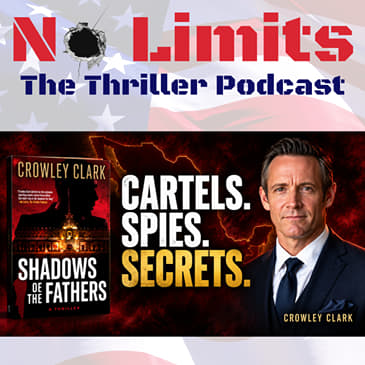
Shadows of the Fathers author Crowley Clark joins No Limits: The Thriller Podcast for an author interview about his debut espionage thriller, Mexican cartels, and family secrets. The conversation begins spoiler-free, followed by a deeper discussion of the novel in the second half.
⚠️ Spoiler warning at 36:00. If you haven’t finished the book, enjoy the opening interview and return for the spoiler discussion after reading.
Follow Crowley Clark and order Shadows of the Fathers at www.CrowleyClark.com.
—
🔗 WATCH, LISTEN, & FOLLOW US:
Website → https://thrillerpod.com
YouTube → https://thrillerpod.com/youtube
Spotify → https://thrillerpod.com/spotify
Apple Podcasts → https://www.thrillerpod.com/apple
Instagram → https://thrillerpod.com/instagram
Twitter/X → https://thrillerpod.com/twitter
Facebook → https://thrillerpod.com/facebook
💬 JOIN OUR BOOK CLUB
Die-hard thriller fan? Join our Book Club on Patreon for exclusive discussions, behind-the-scenes insights, and 24/7 thriller conversation:
👉 https://thrillerpod.com/bookclub
📚 ABOUT NO LIMITS:
• The Mitch Rapp Podcast: Deep dives into Vince Flynn & Kyle Mills' Mitch Rapp series.
• The Scot Harvath Podcast: Exploring Brad Thor's high-octane Scot Harvath universe.
• The Thriller Podcast: Book reviews across the thriller genre: Jack Carr, Dan Brown, and more!
—
#CrowleyClark #ThrillerPod #ThrillerBookReview
[00:00:08] All right guys, today we're joined by friend of the podcast, even our executive director, supporter of the pod, and soon to be debut author with the release of Shadow of the Fathers. Welcome back to the pod, Crowley Clark. Crowley Clark Happy to be here. Thanks for having me guys. Yeah, welcome Crowley. Finally, I get to meet you in person. Obviously, we've been corresponding via text in the group chat. But yeah, excited to have you on again. Thanks for taking the time to come back on.
[00:00:37] And I want to talk about this book. I want to talk about your path, your trajectory. Yeah, so just how's it been going? It's been busy. This has been a lot of fun, but a lot of mental gymnastics in a different way from writing now that I've been full bore into this publishing thing.
[00:01:01] I'm kind of a one man show here. So it's been, like I said, a lot of fun, but I'm learning a lot every day, it seems like. Yeah. And there's been a lot of changes since you and I last spoke. We have a full episode out and interview all about Shadow of the Fathers. And we jumped the gun. That was before you knew your exact publishing route. We told people we'd keep them updated on when your book will become available and what they can expect. And boy, it seems like things have shifted. So back then you were querying. You were looking to go down kind of a traditional publishing route.
[00:01:30] You had the manuscript really signed, sealed and delivered. But you course corrected. So what happened with the shift to indie publishing and this grassroots campaign that you've launched with your massive social media following? Sure. Well, I'm just a little impatient, I think was part of it. I feel like I wrote a story that I wanted to get out there sometime before I died, maybe. I don't know.
[00:01:54] I know. But yeah, I think that was the biggest part of it is a little bit of impatience and really feeling like I wanted to get the story out there. And also, I put a lot of things together to market and push the book in different ways or get it in front of people, no matter which route I took.
[00:02:16] So I always have this in my back pocket saying, you know, if I don't hit a certain point on the traditional route, then I'm going to go with my backup plan, which actually I'm really glad that it's working out this way now. But, you know, through that whole process and querying, I met a lot. I went to Thriller Fest, met a lot of really great people.
[00:02:40] I just feel like the market is so saturated. There's a lot of talent out there and there's just a lot of undiscovered authors out there. So I took this path and we'll see where it goes. And how'd that path begin? Because I know you got a lot of ARC readers through your newsletter, your social media. They've been posting a lot of reviews, creating a lot of online buzz. So what was kind of step one once you decided to go down that path? Step one was announcing it and giving myself a deadline.
[00:03:09] All right. So I said, hey, I've got it at the time. It was a little over three months or I said, OK, I've got this amount of runway. This is kind of the release date that I want to shoot for that mid to late October. And then, you know, I had a bunch of tasks with just announcing it.
[00:03:30] And knowing the first thing to do is really after the awareness, which there's some awareness through social media, is to get people's hands on the book so they can read it and see what they think. What's been like the most difficult thing you you maybe didn't expect to go down this path? Yeah. The amount of tasks that exist.
[00:03:58] I have six different pathways. And if you ask me to name them, I couldn't name them because I have them all in my notes. But six different paths that are running in parallel ads, Instagram, things like that, just to keep things moving. Whereas I know if I went the traditional route, I may have a little bit more support.
[00:04:23] The end of the day, though, it's really up to you as the author to market, put yourself out there and handle a lot of that exposure to the audience. So like I said, I had that planned for a long time. My day job, I get people's attention for a living, I guess we'll say. So I think there was a little bit of an advantage of having done this not for books, but for other things for a long time.
[00:04:54] Okay. I guess it's a good segue to jump up your recent newsletter where you gave a little bit of a challenge. You want to talk a little bit more about that challenge? Sure. Yeah, I appreciate you bringing it up. So I'm not doing this to make money. I've been very fortunate in my career to be in a good position there. I'm doing this because this is a creative outlet for me. And I really enjoyed writing.
[00:05:24] And I'm enjoying this process of getting the book out there in front of people. It's been an amazing road with all the support, all the people that have really rallied around this. And I've learned a lot through this and realized how difficult it is to try and publish a book. Even doing all the right things with a lot of resources is still very difficult. And I feel like there's so many people that are trying to get their stories out there.
[00:05:53] So my intent was to give back a bit. So I started a little scholarship where I say, I'm going to throw a grand into this right away. And then I'm going to set some milestones. And as the book progresses and starts to sell more, I'm going to add to that scholarship. So the scholarship is a Crowley Clark Indie author scholarship. There's an opportunity for it to get up to $5,000.
[00:06:20] So one lucky author will actually come away with at least a grand, but it could be more depending on how the book does. All I have to do is enter on my website and then they'll submit a 250-word pitch that is voted on by all the authors and aspiring authors that entered. So I really don't have anything to do with who wins. It's all up to those who participate and pick the best pitch and they'll get a little lift.
[00:06:51] That's a great idea. I think that's great. Super creative. Yeah, I've never heard anything like that too. As you release your own debut book and the effort that you put in, you also want to give that forward, pay that forward and help somebody else who's just starting out. Maybe a little seed money to get a cover, get a narrator, who knows, whatever steps they need. And I was going to say it escalates, right? You mentioned if your book's successful because that's a unique angle. Depending on how many pre-orders you get, the scholarship can ratchet up. It is tied to pre-orders.
[00:07:21] So the math that I did on it is, okay, depending on which route you go, whether it's an e-book or an audio book or the print, you're not making a ton on it. So I took the dollars that I would make and said, let's flip that into additional scholarship. Scholarship. Wow. Yeah. Also, the way people can participate in that, they don't have to order their book or do anything. They can just go in and request the book through their library.
[00:07:53] That's easy enough to do. People need to pre-order the book. Come on. People need to pre-order the book. I'll give a plug. Get the audio book. I was so excited to read this the first time in print. And, you know, we're big audio book readers. So the whole time I'm wondering who could pull off all these different accents. You got Victor Chernov. You got a Russian. You got a whole lot of Spanish speakers. You got a Brazilian. I just think there's a whole eclectic mix of voices. And how did you end up with this narrator? Because he was fantastic. Eric G. Dove.
[00:08:22] I thought the audio book narration was phenomenal. Eric, if you guys look him up, I'm going to give a plug to Eric. So Eric is a very talented man. He's run a YouTube channel for living on a sailboat for a long time. Very cool. He's been a musician. But he is a talented narrator as well. He's narrated hundreds of books on the boards.
[00:08:48] I heard him first listening to the First Blood Rambo series. And it was interesting because there's a lot of interior, I guess, internal monologue in that book. And we'll just use the first one as an example. And I just thought he did such a nice job of keeping the same voice, but just really making it very clear that there was this internal dialogue happening. Then I had some conversations with Eric.
[00:09:18] And I said, well, how are you with Russian accent and Spanish accent and all that? And he actually pointed me to some samples and blew me away. So I knew once I heard that, I was like, Eric is it. And he's great to work with, too. So just really positive. And I think he did a wonderful job. So he really brought the book to life better than I imagined. No, I was going to bring that up.
[00:09:47] Thank you for allowing us to listen to the audiobook. And I let my wife listen to it, too. She's really digging it right now. We haven't quite had a conversation with her about it yet. She's not done. But yeah, now I realize that you told me to look him up where I've heard him before. I've listened to some W.E.B. Griffin books, and he's done a couple of those. So yeah, he's very talented. Nice gift for that. Thanks.
[00:10:38] Yeah, thanks. I want to dig into it thriller pod style. What was your reaction to the action, the plot, the character development, the arcs? You know, if I had to give like a one sentence pitch, I'd say it's like, you know, it's very much like what I saw online. Jack Ryan meets James Reese. Like, I like the complex bringing in of, you know, this analyst, you know, the hunter character.
[00:11:05] You kind of get the sense that he has like all these abilities, but he's not like quite, he's not the gray man, but he's, you know, but he's definitely is capable. I like that ability, you know, kind of like has that relatability to him. And then just, I don't know, I like being in the Mexican drug world. Like every time, like we've gone into that either with, you know, mid trap series or some other series. I don't know. I, I, I watched like Narcos and like, um, you know, what are some of the other Netflix shows? I don't know if something is different about that.
[00:11:35] And then you tie in the whole Russian aspect of all, I thought it was a nice blending together of, you know, bits and pieces of different books that we've read that I've enjoyed. And I think, you know, really solid, uh, debut author work. I'd have to say. Thanks, Chris. It's funny. You mentioned, uh, Jack, Jack Ryan meets James Reese, because would you look at that? It's right there on the cover of the book, a quote from thriller podcast Crowley Clark
[00:11:59] delivers in this explosive Jack Ryan meets James Reese debut that won't stay in the shadows for trying to do organic, organic plug there, Mike. And you kind of just, yeah, but I blew it. Hey, I'm going to toot our own horn. Thank you Crowley for including us on the cover of your book. Yes. Yeah, I appreciate the, appreciate the blurb there. Um, yeah, it means a lot. I mean, it's, it's interesting to hear everyone's perspective. A lot of people pull in different things from, from, uh, you know, authors that they've read.
[00:12:27] But, uh, yeah, I, I think it's, it's fun to hear what people think of it because everyone has a little bit of a different take. Yeah. Yeah. So, uh, yeah.
[00:12:56] What the story's all about and how you crafted it. Okay. Sure. Yeah. Some of the things people will be really familiar with and comfortable with, right? So you have like the idea of this Jack Ryan. It's almost like the CIA analyst and going into the field as a trope, right? So you have that familiarity. Um, Chris, you already mentioned the, the Mexican drug war. So we have this CIA, um, care main character who is involved kind of a fish out of water,
[00:13:25] if you will, involved in the backdrop of the Mexican drug war. Now, a lot of things have changed in the last couple of years in Latin America. I just read an article today about how, uh, the United States is trying to keep up with what's going on with China, really developing and doing some things in, in Latin America. Um, but I, I wanted to tie that in a little bit more of a global scale than just Mexico.
[00:13:52] Um, so you have that kind of geopolitical piece to it. You have the, the cartels, you have the analyst, all that's mixed together. But the other thing that you're going to get is this family saga, right? So there's a drama, um, not only with the main character, but a lot of characters that are dealing with the consequences of their, um, upbringing, the decisions that, you know,
[00:14:20] maybe their parents made or even their grandparents made in some cases. Uh, so I wanted to bring that in and bring a different layer. The other thing was, and I talked about this on the podcast before, but I feel it's, it's worth repeating is a lot of these characters that we read about. They're the fully baked, ready to go action hero that don't always have an arc. There's a lot of action. There's a lot of things happening.
[00:14:43] Plots get resolved, but how is the character developing and how are they feeling about all these things that are happening? Um, seems like, um, not a lot of books give a lot of attention to the emotional component of working or emotional components of working in intelligence and the heavy toll that it takes on a lot of lives. It's not just intelligence as a military is another example where, I mean, it's mission 22, we've all seen it.
[00:15:12] 22 former service members or service members take their lives every single day. So bringing that humanity in was important to me too, because I've, you know, I've known people with a lot of trauma, um, for different reasons. But, um, I think it was important to kind of bring that kind of humanity and hopefully give it a little bit broader reach, uh, than just your, your average, uh, you know, spy thriller.
[00:15:42] Yeah. Also, you know, we can get a little bit into spoilers a little bit later, but did you want to bring, uh, an aspect of like, uh, spirituality or surrealism into this? Was that on purpose or did that just kind of like flow, flow out? Yeah. Definitely picked up those, those elements throughout the book. Yeah. So I, I thought it was interesting just because we're in Mexico and knowing the culture,
[00:16:08] having spent a little bit of time and parts of Latin America, there is a different cultural aspects that I wanted to pay respect to and also call attention to in a little, a little bit. So there's some apocalyptic themes, not in the kind of woohoo sort of way, but there's, there's some propaganda used by, uh, the cartel there. But if we, if you study what's happening down there, there's a lot of following of the
[00:16:35] Samta Muerte, uh, there's, um, Santeria, which is, you know, worshiping saints. Um, I grew up Catholic, Mike, I think you grew up Catholic too. Chris, you two? Yeah. All three of us here. So we went to the Catholic university. Catholic university. Yeah, sure. Yeah. So I went to Catholic school my, my whole life, not in college, but, um, so there's that, that American perspective that we bring. It's a little bit different, same religion, but there's some differences when you get, um,
[00:17:05] south of the border. So, um, I wanted to bring a little bit of attention to that and then just pull in some contrast. So I try to bring in some areas of gray. So the drug war itself, there's gray, this, you have this old world superstition and then you have this like advanced technology and, and those worlds colliding creates this sort of push pull with the gray, which I wanted to bring in, in different places too, just
[00:17:31] to not to be the, the judge, but to kind of serve it up and let people kind of draw their own conclusions about things. Yeah. I think that angle is what makes you unique because I feel like I've read a number of stories. You referenced this earlier, Chris, uh, either taking place in Columbia with the drug wars, uh, the FARC and guerrilla fighters or, uh, somewhere else in Latin America with the drug trade, or even Kyle Mills put it a little bit into the Mitrap series with drugs coming out of Syria.
[00:17:58] Uh, I feel like that's been done, but really different than you captured the local culture, the kind of flair that this would take on in a country like Mexico, where even the drug Lord has sent them where today, this cult of, uh, the Holy mother, but also being the patron saint of death, uh, all tied into one on the side of his airplane on his tattoo, not giving away too much, but you've created a really intriguing villain.
[00:18:24] But the same way you wanted our main hero to be going through his own doubts and have his own insecurities and have to go on that journey of becoming fully who he is to complete the mission. You've done the same with the villains. What was it like creating this cast of villains? Some of whom I don't want to say I'm fully sympathetic for, but make some moves that I think are a bit more understandable. Other ones who are straight through and through terror, like absolute terror, um, uh, with a general and the military angle.
[00:18:54] I feel like your web of villains is almost just as complex and people that go on just as much a journey as your good guys. Did you set out to do that as well? Or did those characters just come to life as you were writing? Yeah, I think they just came to life. I mean, a lot of this, I'm more of a, I'm a little more pantser. I would say I plan high level, but, um, I wanted them to be human. Um, and there's an, if you think about it, we don't, there's all, all the cartoonish,
[00:19:22] like a Bond villain, um, even Blofeld's got his cat, right? So you're like, oh, he's got a little bit of a heart. He's got a cat. Um, but yeah, I think, you know, everybody's complicated and even, you know, everyone was a little kid. They just wanted a hug from their mom and dad. Right. Um, at some point. So how did they get to that point where they just, they want to, they have so much evil or so much hate that they want to do what they do.
[00:19:47] Um, there's a, it gets really interesting when you think about the perspective of the villain, where they think they maybe think they're even doing good, right? Or they're, you know, they're serving themselves, but not always they're, they're, they're thinking of others too. So, um, depends on whose side you're on. And so I tried to put you in the heads of the different people to give you an idea of how they were thinking, how they're seeing the world and, uh, just humanize it a little bit more.
[00:20:14] I think similarly, it becomes more real, comes more human and more real with the pressure on the actual government. Cause again, another angle you have to cover with Mexico is there's a fine line between the cartels running the show and the government and the military running the show. And they might be more embedded and more intertwined than we think. And, and that's of course an angle that you cover as well. So I feel like probably you, you run the gamut on what you decide to cover in this book. It covers a lot of ground.
[00:20:40] Um, you even mentioned the China and Russia of it all, but I feel like everything's authentically brought together and it's authentically brought together through the characters, the characters and their relationships. So even as a pantser, I feel like some people can go off the rails and in different directions. I feel like your universe just tied very nicely together. Appreciate that. Yeah. It was, it was a lot of fun. It, it didn't, didn't happen easily. I'll tell you that. And, uh, just to ask it again.
[00:21:09] So where did this idea for Hunter come? Obviously he's your, you know, piece de resistance. Like in, I think he's the one, I don't know, maybe it makes sense, but I, I sort of liked him the most out of, uh, all the characters. And I thought that he was this newer, you know, just a different take on like the same kind of thing we see. And so I'm interested to find out like why you wanted to tell his story. Yeah. Good, good question.
[00:21:37] Um, imagine what it might be like to be the, the offspring of James Bond. G Baker, love G Baker. And I mean, it's interesting to think about, you know, you have someone, I mean, you see this with football, you see this with all kinds of things where like people get to what you would almost view as the pinnacle of something. And then they have offspring and it's like, can their kid do it? Right. Or their, or their grandchild do it. Right.
[00:22:05] So I thought, wow, this, there's a couple things that fed Hunter, um, as a character. And one was just the idea of this, um, living in the shadow of, uh, of a great man who was kind of a super spy, lived outside the wire for a long time. And those maybe at times unrealistic expectations placed on this person who is like, am I doing this because I want to do it? Am I doing it because I was brought up to do it?
[00:22:32] Am I doing it because, you know, why? Why? Just asking the question. So, um, you and I talked about this last time, Mike, but there's the, the element of, of, you know, kind of carving your own path versus just following in the footsteps of the people that came before you. And there's a lot of push pull, uh, generationally sometimes a lot of pressure. I know personally, I was put under pressure as a young man to, you know, take certain paths
[00:23:00] in my life because my grandparents did or my parents did. Um, so some of that was personal for me. Um, the other piece with Hunter specifically, it's not exact, but, um, I don't know how much I'm going to say here, but a family member of mine, um, had an interesting career, we'll say, working for the government.
[00:23:23] Um, and some of those pieces that I pulled in the book are, are true, just rewritten in a different way. Um, right. So imagine being a, um, a child and you're a lot of people with, with family, they're in the military, they're gone for, you know, somebody might be deployed for 18 months or something, right? A long time. Um, you don't know what, they don't know what they're doing. They don't hear from them. There's, so there's a lot of that.
[00:23:52] But anyway, um, I brought a little bit of that in there, just, um, you know, what might it have been like to be this person with all these expectations set on, on them and not really knowing what they wanted to do. So there was some personal things there too, I guess. Um, and then I went back to the, the idea, Chris, of like not having a fully baked character. Like how did James Bond become James Bond? He had his first, first mission, right? I think, what do I have? Um, I just bought that book.
[00:24:22] Um, anyway, it doesn't matter, but there's, uh, you know, that origin story you talked about, like, American Assassin wasn't the first book written. Um, you know, it's, you have the, the prequels later on to kind of figure out where did this character come from? So I thought, why don't I just start with that? See what happens. There's, there's even more that we could dig into, right? You left enough on the plate that, you know, obviously this whole backstory with the boxing,
[00:24:48] um, you know, I'd be like, I would even read a book as him as an, he seemed like a pretty good analyst too. So, um, yeah. Yeah. And then also you could totally go into a backstory of his, his grandfather, you know, Susan, Susan, the boss, she struck me as an Irene Kennedy, Thomas Stansfield type leader at the CIA. Yeah. Some storytelling there, but everything you're saying, and I mentioned this on our first pod, I think right now it bears repeating the title of the book.
[00:25:17] Like almost everything you've discussed with us tonight fits so succinctly and ties back to the shadows of the fathers. I mean, you even say in the book, how could the sun rise above the shadow of the father? Yeah. And that quote might actually, um, we had the rug pulled out from under us. There's a lot of fathers, a lot of influences, a lot of family in this book, but there's one other side of family that's a reveal. And so that might be something big we'll talk about, uh, in the spoiler section.
[00:25:45] Um, I absolutely love all this, but another quote I picked up on this read was long Hunter long. You mentioned bond twice already. I do think I remember reading long Hunter long. Did I not? Uh, somebody's reviews of that actually. Okay. Is that what it was? Everything in the book screams so much bond that I feel like when I met Hunter long, he came off at the, as this like buttoned up, I could imagine him coming off the casino tables playing.
[00:26:13] It's so cool outsmarting people, but then he can also kick your ass behind, you know, closed doors. So I guess everything just felt like bond, even the level of writing that you put into this. Yeah, no. So I got the bond quote wrong, even though everything screams bond, but another quote that still got stood out to me, this reread secrets only sleep for so long. Another thing going on here is that everybody's got maybe some skeletons or maybe some insecurities.
[00:26:40] And, uh, I think this plot can only go as it does if you face those and it's tough to face them for everybody. And we even have two women characters who go on large arcs here. Uh, what was it like writing these two very intriguing, uh, very bond girl esque, um, uh, female characters and, and one who I, I actually am kind of falling for and one who might be even worse than I thought she was in the beginning. Maybe not as dumb as she looked. Was she playing us the whole time?
[00:27:09] What was it like creating these really complex female characters? Uh, as much fun as the rest of it. I feel like we had to have a, uh, a group here, right. And you have to have the, the love interests. I don't know. Maybe you don't have to, but I feel like there needed, there needed to be some balance there. Uh, and I thought it would be interesting to see where the cartel scion went.
[00:27:35] Uh, I wasn't sure exactly where that was going to go, but, um, it, it was fun kind of getting to know them and, and watching them develop. Um, Aria, who is, uh, the Brazilian that you were talking about earlier, Chris, that, um, has like the, the bit of mysticism there. She's the, uh, the tarot reader and has some other, other things going on. But, um, yeah, she, she was an inspiration, a little, a little homage to the live and let
[00:28:03] die, which is my favorite Bond book by far. Um, such an excellent read. And, uh, I wanted to give a little bit, uh, of, um, I don't know that feel to it without going overboard into the realm of the supernatural too much. Yeah. She was a good vehicle to do that because she also had to know when to lean into that side of her, her character, like address the spirituality and use it to her advantage or maybe mask the
[00:28:32] truth, not lie about what the tarot cards say, but know how to get the upper hand and play the game, right? If you're going to be a pawn in someone else's political cartel power structure, I feel like she came into her own and found her own way to mask intentions and achieve certain names. So yeah, I liked her a lot. And I also liked the fact that, you know, we do get to be in her head a little bit and we get to understand that, you know, she, yes, obviously she does believe in some of
[00:29:00] this stuff, but she even says that like most of her power comes from just being, you know, Oh, ultra susceptible or perceptive, perceptive of the world. And like understanding, you know, really that's how you can actually see things is by just looking at people or listening to people. So yeah, right. It sounds like realism into it. It sounds like we're waiting into spoilers. Like we are, we are a little bit, a little bit. Do we want to talk about these, these packages? Oh wow. Yeah. Yeah. Yeah.
[00:29:28] I almost forgot about the, this showed up at my door the other day. What, what, what might this be? I'm dying to open it. It's like Christmas. You guys should open, open your packages. All right. We're going to open it right here with the, what was this knife called? The regiment blade, courtesy of Tyler Booer, fan of the pod. So here we go. Classified top secret. I don't know, Chris, does your, your box have classified on it? Mine says classified top secret. It's got the Crowley card logo.
[00:29:58] Yeah. Look at that. Gotta love the hay. Yeah. Yeah. I got a letter. Mike, you're normally doing the unboxings. And then I got something in the packet. You'd like my kids. Is there anything else? Nope. Nope. Okay. You sure about that? Oh, God.
[00:30:30] Oh, oh. Oh, there we go. Oh, I got a, a black light. All right. Oh, don't put that in your room back there, Chris. Watch out. Oh, my mom listening to this podcast. Come on. All right. Confidential. I should, do you want me to read this out loud?
[00:30:59] I don't, I don't think I should. That's up to you. You guys can give the, the summary. So you're, you're experiencing this live or you're experiencing this in real time. Oh, this is cool. This is always what I've, I've seen some of these on like gamer, uh, Instagrams I follow, but it looks to me like this is like a mission that I have to like the field brief confidential years. I was only target. Let me tell you, Crowley puts in the work, man.
[00:31:27] Everything I've heard and seen online from him is just top notch. And this is class right here. A mission brief. Oh, this is something. And I mean, before I even get into that, I had to hold up my phone before because the earlier copy you sent me not only had the older cover, it didn't have our quote on it. So now I have my very own Crowley Clark shadow of the fathers with the thriller podcast blurb on the front. That is class.
[00:31:56] I like this style. I don't know. What's that? Like, uh, the mat. Yeah. As a matter of that finish, a hundred percent. Well, we haven't even, we haven't done talks about the cover yet. No, really, really liked the cover. No question. Is that you? You were the model for this, right? Crowley. That was not me. No, come on. This is your opportunity. All right. Fine. It was Mark Harris. All right. We'll spoil it. It's Mark. Yeah.
[00:32:26] Brad was the, uh, the backup if, if Mark's pictures didn't come out. So thankfully we didn't need him. All right. Chris, we got some work to do with these pages. We do have some work to do. Maybe we could do a whole pod reading, uh, reading these things out. This is sick. Thank you for that. Ryan Pote, Ryan Pote, giving you a couple of good blurbs here. I heard you're going to be on Spybrary as well. You reached out to those folks because that is a big, that's a big gap.
[00:32:56] There's a, there's a spotlight they're doing. Yeah. So not the, not the podcast, at least at this point yet. So we'll, we'll see. I'm trying to, to fit some things in my schedule before the book releases. So we'll see. Yeah. Their content is up there and their following is hardcore. So you sent how many of these out? 40. And actually there's only been, um, right now the, the first two waves, have gone out and it's 30 that have gone out. So I've got 10 more to, to get out, out to the world.
[00:33:27] So. All right. One for each of you guys really appreciate shit. And yeah, I know there's a lot there. So, uh, maybe I can give you a little bit of a highlight. There's just, uh, there's a mission there. And, um, I see the last page now. Yeah. There's equipment in that, that box that will, um, give you a little bit more, uh, yeah. Give you, uh, another place to go. So, um, maybe you can play around with that later, but I wouldn't throw anything
[00:33:56] away just yet. Cause you never know what might lead to a clue that came in that box. I have to find the six digit hidden code to get my clearance. Oh, there's something in there. Okay. All right. Hold on envelope. I'm doing it now, but yeah. All right. And then I'm done. All right. Nope. All right. That's going to be fun. I like that. Okay. Well, I'll be interested to see, uh, how it works out for you guys, but, uh, I appreciate you having a little fun with that.
[00:34:27] No, definitely. And so before we jump into the spoiler section, tell everyone when the book comes out, where they can find you, you know, give us all your plugs. Okay. So the book shadows of fathers. There we go. Comes out October 20th. Sorry. Sorry, Crowley. I found my code. You found your code. Okay, good. All right. Well, that's more exciting than, than this kid. Uh, all right.
[00:34:56] So you, you're, uh, you're making progress on your mission. Uh, book comes out October 20th. It's available for pre-order ebook, audio book, and print. Um, you can find it about anywhere. So, um, you know, your Amazons, et cetera. So it's all over the place. Um, you can find me at CrowleyClark.com or on Instagram at Crowley Clark books. Um, outside of that. Yeah.
[00:35:23] Just appreciate everyone, um, you know, taking time to explore this and, and bet on a, on a debut thriller. Um, but yeah, it's been a lot of fun, um, you know, going through this process. Um, I think, um, I think, uh, it's, it's definitely worth everyone going out there, picking this up, reading it. Uh, it's going to, it's just a different, you know, it's a different take. On like the same kind of, I don't want to say tropes because that like kind of diminishes it, but just like, I don't know, a breath of fresh air in terms of giving us something new.
[00:35:53] Um, and you're right. There's so many independent, like, and the world is just saturated right now by like, you know, 10 brand name authors that get pushed. When are, when are their new, their new thing going to come up this year? And it's nice to like, I appreciate what you're trying to do with this whole scholarship thing. I like, you know, pay it forward. And so encourage everyone to go out there, pre-order this. Let's get that scholarship up. Uh, and let's, let's get Crowley Clarkson, some sales. Let's do it.
[00:36:23] Appreciate it guys. Most spoilers. Where do we want to begin? One thing I wanted to ask you about was the baby and Bianca and how she extricated herself. You can't just jump to book two right away, dude. Dude, I want to know. Okay. If I'm going to jump to book two, then let's get to that epilogue. And again, spoiler warning. You got to read the book because something is thrown at us in that epilogue of is Ruben alive. Is he the next, is he the bad guy?
[00:36:50] I had thought Hunter found peace in the very end. And then all of a sudden that drone scene, you pull the rug out. You pull the rug out. Yeah. You got us going Crowley. You got us hooked for book two. My editor advised me to not do that, but I, I had to happen. Um, I, that was one thing that I was like, there's, there's this one final twist that had to, had to be in there.
[00:37:18] And, and yeah, I've already thought about the second book. I'll, I'll give a little bit of a high level highlight and say the theme is revenge. Right. So to think about what that might mean with the, the cast of characters that are in the first book or some of those, the, the ones that are alive still, I guess. Yeah. Um, so that part, I just wanted to kind of, you know, end the story, but also set the
[00:37:43] table for a possible, uh, book two and we'll see what happens. But do you, do you guys have, you have questions about that or, or, uh, no, I think it, I think it sets it up nicely. Um, obviously you, you leave us with, you know, you have the, the whole Victor piece. Um, you know, what is he going to do in, in Russia? You know, how's that going to go?
[00:38:06] Uh, you have the entire, you know, what is, um, Bianca going to do, you know, now that she's just going to live her life with, you know, obviously people are watching after her. And then, you know, what is Hunter's next mission? You know, you even say like, or he asked, he has a bunch of work to do. You just, so it, while it ties it all together that it doesn't necessarily have to go on, but it does leave, obviously we wanted to go on, but it leaves enough like meat on the balance to like be intriguing.
[00:38:35] Like, Oh, like that's, you know, it's not, it's not too big of a, uh, what, uh, not too big of a cliffhanger, but you know, just, just the right amount of cliffhanger, I guess. And if it did feel good. So I could see where the editor's coming from. It did feel good to get closure for Hunter that he's not going to have to keep chasing this revenge plot and keep thinking about retribution. And he was already so aware that that's, that's a bad path to go down.
[00:39:01] But once you find out this guy's alive, I don't know how you stop yourself from going down there. So it's like, I would have liked that the, you know, everybody lived happily ever after and Hunter found his place, went on his mission. Doesn't have to worry that he killed some guys because he's all done and everything was buttoned up. He can like just work on himself, go back to the desk and just work on yourself. Yeah. It, it, it was nice, but something felt incomplete. Like inside of me there, like you doused the fire, but the embers were still glowing hot.
[00:39:29] And then the drone scene kind of, you know, was that, that rush of oxygen to get the embers burning again. So I, I wonder what you're going to do with that. Yeah. I mean, Hunter was going to have to look over his shoulder one way or the other. Sure. That's true. Anyway, that's true. I mean, that's true of being in that line of work, right? You, you may just meet an early death one way or the other, but this kind of puts it front and center and it's like, Ooh, what might happen now? Yes.
[00:39:59] I want to jump back to the beginning of the book and ask you about, so this story of Hunter killing a guy in the ring, like where did that come from? Why did you feel like that needed to be? Cause obviously this plays a big, big toll on him. He thinks about it multiple times. It comes up during his, his crazy, you know, the dream sequence, both the dream sequence in there, whether it's in the hotel or in, in the jungle. Um, was that just like another take to really add some, what you were saying earlier in the
[00:40:29] non-spooler section of like that oftentimes you don't see that people like thinking about their consequences. Was that, and then was that just like another element to bring that to this character? Yeah. It was a mechanism to create the, the sense of fear and doubt. Um, I mean, we've all been, we all know what a slump is, right? You kind of, you know, you may be, if you use the sports analogy, we'll, we'll just say,
[00:40:55] you know, you have people that are very talented that have all the opportunity to do something very well that just can't, right? For whatever reason. So this was a means of, of taking a very talented individual who was set up for success his whole young life, uh, and then had this, this setback happen that shifted his path completely. Uh, so I don't know.
[00:41:22] And I, the, the boxing thing is just, you know, I, I did a little boxing when I was younger. And, um, so there's, there's a little bit of familiarity there. So, uh, yeah, I, I just thought it was a little bit of a different take. Um, the plus the Mexico thing, right? There there's, um, culturally it's, it's still a very popular sport. I mean, it's still a popular sport in a lot of places, but, um, yeah, I thought that would be kind of an interesting piece to, to tie in.
[00:41:49] Um, it's another way, it's another way to bring in like his characteristic as, uh, you know, that he couldn't be a, a fighter, like, you know, that he has strong. Yeah. It sort of adds to his bona fides that, oh, this actual analyst could actually do some of this stuff, right? You can go toe to toe. Yeah. Yeah. I think another take on it is, and it's subtle, but I think it's pretty, pretty deep of a lot of characters. If you do an origin story, we have to see them grappling with their first kill.
[00:42:19] And so they're given a mission. I'm Mitch Rapp, right? Remember sitting on that bench in what is it? Istanbul. Um, and I feel like that's been done before where this time Hunter had already killed. It was just an unintentional kill. Right. So what is it like then having to gear up and go into battle when you're already dealing with this emotional baggage of having killed as opposed to the young raw recruit going in
[00:42:46] and killing for the first time on the job? He has to do that. He has to kill for the first time on the job out of necessity. And he grapples with that, but it's so much deeper knowing he had already been dealing with that for a much longer time than just somebody like a Mitch Rapp, uh, being recruited out of the blue. So I just feel like that was a, also a subtle take on Hunter long that set him apart. I feel like there were a couple of things. And then the family connection, Chris, you said this to me when you were reading, we learn about Victor being the uncle so early on. Yeah.
[00:43:16] I was wondering if you ever thought about like playing that out. Like I, cause I felt while in the end it worked. Um, but I, as I was reading, I was like, Oh, like this would have been, um, interesting, like heel turn towards the air, like, you know, or a big twist towards the end. Oh shit. He's his uncle, you know, like that kind of thing. Yeah. Was that ever like an option for you? Um, and actually the, the beginning of the book was much longer in the, in the initial draft.
[00:43:43] So you didn't find out or Hunter didn't find out about that for a while. So you got to know Victor and the, um, and I may do a little bit more of an origin story or a short, uh, based on some of that writing, but, um, you know, I had all the details of what happened the night before and the restaurant and all that. Like there's, there's pages and pages of stuff that didn't end up in the final draft, but, um, you just hear about it later.
[00:44:10] Um, yeah, back to your point, uh, a minute ago, I don't know that Hunter would be cleared for field duty really based on all the stuff, like his doubts and all the things. If you think the reality of it, what I, I believe is like Hunter was because he has this pedigree, right? So they kind of overlooked certain things knowing that there's some talent there. It's like, yeah, he's just nervous, right? This, get him out there. We'll see what he can do kind of thing.
[00:44:39] And there's also a disposable nature of, of, um, people sometimes too, I think that, yeah, could, could come into play. You do have a point like would Hunter probably would fail his psych eval, like before they maybe cleared him to, to go into the field. Yeah. But that ties into the uncle of it all of why Susan wanted to fast track him one, knowing the family history, um, knowing that he has the skills through the boxing as we saw, but
[00:45:06] then also the mission was so delicate in that you can even see Raul and others dealing with, I don't trust this Victor guy. I don't trust us with this Russian. He was a double agent. He was a mole. How do you know he wasn't playing us the whole time? Like you needed the familial bond, somebody who was going to trust Victor and Victor would trust him or else. I think a lot of people, we would have had a lot more Rauls even on our side, which he was very interesting with what he did.
[00:45:33] And now he goes out and I guess you could say in a blaze of glory, you know? Yeah. But is it ultimately futile? Did he, it was he one of the bigger tragedies of this story looking back? I think so. Yes. So actually I had gotten a discussion about this the other night with a friend of my wife's who read the book. Um, and she's usually reads like fantasy and other things.
[00:45:55] So it was interesting to hear her take, but, um, she said that was a really rough piece to read. Um, I'll let you guys in on a couple of little secrets. Uh, won't go into too much detail, but the, there's some truth to that, that actually there's a, an individual that I interviewed for the book that had a similar situation happen.
[00:46:23] He didn't, he didn't go down in a blaze of glory, but he found a piece of a person that he, um, shot in the face, uh, like three days later, something like that. Um, there's, and I say that and I'll go a little further with this, that, you know, people tell me that this book is gruesome and there's some pretty, pretty rough stuff in it, but I didn't have to make a lot of this stuff up guys.
[00:46:50] I mean, this stuff happens on the regular in Mexico and other parts of Latin America and in the world, the world is a violent place. And, um, I, I put some of that in there. Obviously people, some people like that, but there's, there's a little bit of a reality check and how lucky we are to be where we are and how difficult it is for people to go into those type of positions and that type of work and do that.
[00:47:16] And again, it goes back to that, what I talked about earlier, that psychological toll that happens. Um, Raul specifically was a, I had him envisioned as almost this Judas Iscariot kind of, uh, character, right? Where I knew he was going to betray Hunter, but he didn't really have a choice. Yeah. Um, so yeah, it added a different layer to it, but, um, ultimately it worked out. I wanted him to be the wingman.
[00:47:45] I wanted him to be the loyal wingman through and through thick and thin, the Scott Coleman to the Mitch Rapp and when he sold him out, I was like, shit, you know, he knows the reality of Mexico better than anybody because he's tried to fight it. And I think he knows it's a losing battle and it just sucks that he had to go out that way. It does. I mean, you think about, I said earlier, this gray that's in, and you mentioned the corruption of the government. Well, we could just say, yeah, they're corrupt, but what's actually happening.
[00:48:11] A lot of times is you have people's families are threatened or I mean, you're really, there are a lot of times given no choice. It's not that it necessarily makes it any better, but what would you do in a situation like that? So I wanted to not be the judge, but just again, serve it up and let people kind of make the decisions and say, could I decide? Um, the gray is fun to play in. Yeah. Sure. No, sure. Yeah.
[00:48:41] Talking about gruesome, you, you start the book off with a banger with, uh, with quartering Tony Cruz. Yeah. That was intense. That was like, um, I mean, did you have any feedback? Like, whoa, this is a little too much. Like, or people like, oh, I dig it. It really like hooked me into the book. Like what, what, what are other readers out there saying? I didn't mind it, but like, you know. Um, no, I mean, I think, you know, there's probably a few people who just put it down after
[00:49:08] that, but, um, yeah, I wanted to set the tone early and, uh, you know, this is kind of what you're getting yourself into. Um, but I, I imagine when I ride it, I have, I, I see it. Right. So I'd imagine like what this would look like on a screen or, or what you, what you would see in, in, um, real life. And, um, again, you're contrasting this beautiful beach and this, this nice place, a nice restaurant, you're just having a meal.
[00:49:36] And then you have this terrible thing that's going on. Um, it's like the opening to a white, white Lotus, uh, season like that, that, that had the feeling of it, you know? Yeah. You know what I mentioned in our last episode, which Chris, I don't know if you heard everything about this book and including what you're saying, cause there's a meal scene, the night manager season two specifically. Did you see it, Chris? No. Oh, so they go off book from like crazy, the night manager in season two and they make
[00:50:02] up a storyline, but it literally takes place in Columbia with the drug Lord who is so close to Santiago Arias. It's not even funny. And there's a woman who's caught up in it and she's playing both sides, but she's also young and innocent at the same time. And then the same, uh, same guy from the night manager, the night manager himself also gets embedded. Uh, he's going to play a double agent role. It's happening like the battle of Torra Blanca. That's what I tend to call it.
[00:50:32] Maybe the siege on Torra Blanca, that huge set action piece reminds me so much of this guy's complex in that show. So, so like the visual language that the, the show creates in the night manager season two and the visual language you create the vivid, the, the vivid, you know, colors and locations. It's, it's so close in my mind to what I saw in that movie that it helps me picture everything that's going on. It's just, it's just insane how, how well I could visualize it one because of that show
[00:51:02] and two because of your writing. And we're talking about the quartering and the Tony Cruz kill and, uh, Ruben Flores and general Ghilardi are absolutely not. So, uh, but I think the most satisfying kill is Bianca on Santiago. Oh yeah. That climax in the heat of battle and he's just coming to, and he's given her lip about the baby. She just snaps. Did that feel good writing that scene?
[00:51:30] I was a little nervous about it because I was like, doesn't, doesn't Hunter need to do this? No. Right? No. I liked that it was her. Yeah. Yeah. It, it, it just did after a while it seemed to fit better. And, um, yeah, I mean it, there was like, she needed, she needed justice too. Uh, so yeah. And I guess it's kind of related to her arc too. Yes. It brought her into her own. And it kind of relates back to Mike's earlier point that, you know,
[00:51:59] the way I saw Bianca early on, I obviously, you know, she's, she studied abroad, you know, she was intelligent, but I, I, I guess I had this feeling that she like, you know, didn't fully have everything together. But then by the end, you realize that like, I think she was actually playing chess while the rest of them were playing checkers. Like, were you trying to establish that? And like, she's actually like the kingpin behind it all or like, or am I like completely reading that wrong? Is it self-preservation?
[00:52:28] That's how I read it. Yeah. I think it was a little more, um, I mean, I didn't know everything that was going to happen. So I was getting to know them as I wrote them and, and put them in different situations. But, um, yeah, I knew that she had to have an arc and I knew she was kind of in denial at first about her dad and not really just like, oh my gosh, now what do I do? I've, I've kind of now my, my life is depending on being with this, this person.
[00:52:58] Right. And now what? So her options shrank and, uh, yeah, she kind of had to work through it and figure out what was happening. But yeah, she didn't really want to believe it. She didn't want to deal with it at first. And, and then she kind of was forced to deal with it with, uh, the housekeeper and then some other things. It was just like, all right, this isn't the person that I've hoped he might be. Um, he's worse than I thought.
[00:53:27] And I need to start thinking about plan B or whatever. Yeah. And Ruben helps her. She calls, you know, she calls on uncle. Unc is there for her, but I don't think he really feels for her because he killed her father. He gruesomely killed her father. He was willing to use her as a pawn with the whole Santa Muerte of it all. So, and then he even says at the end, like, I'm going to keep watch on her to make sure she doesn't like get out of her cage or overstep any boundaries.
[00:53:55] So I think she's almost thinking he's going to protect her. Like he got her out, but he's more ruthless than that. So are they all going to show up? Are we expecting the same cast of characters in book two or are we going to make a pivot? And it's more of a hunter. You'll see. Yeah. You'll see a lot of these same, same ones, the ones that remain living. Um, yeah, there's an expansion. Um, but yeah, there's, there's some different storylines. Chris, you mentioned Victor going to Russia.
[00:54:24] There's, um, maybe a year will. Have passed really. Right. So if you think about reading the book, the next one comes out about a year from then. Um, so, you know, Hunter's off training right now and, you know, you have things going, but, um, yeah, I think, uh, we'll see some of the same, same characters. Um, I've got a good chunk of it written and another chunk of it in my mind. So we'll, we'll see what happens, but thank the theme of revenge. Okay.
[00:54:54] Not giving away too much, but can you also tell us about a location? Cause this was, this was the Mexico book really. Um, are you kind of keeping us in the same part of the world? Yeah. Uh, let's see. Definitely. There's a, uh, we'll be in Europe. Um, we'll be, um, in, uh, I'm trying to think. It doesn't say too much. Yeah. Yeah. Uh, there's some, uh, South America, we'll be in Mexico a little bit, but really not, not too much. Okay.
[00:55:24] Um, it's really, we're getting on a little bit more of a global scale where people are spreading out a little bit more. Um, I wanted this first book to be very linear, right? Yeah. It was starting kind of in the, in the, the U S going down to Mexico and getting Hunter. It was really following Hunter's path of getting further away from safety, right? He has characters peel away. He's getting pulled further and further away and ultimately has to figure things out on his own. Very far from home.
[00:55:54] This next one is going to spider web a little bit more, but I'll, I'll figure out how to weave it all together at the end. I hope. And I noticed that like at the beginning of each perspective, you put like a timestamp with like, you know, day, day five, day seven, whatever was that, you know, harking it back to like 24. I kind of liked that because sometimes like we, it's hard to like piece together exactly how much time has gone forward.
[00:56:21] Um, was that a conscious effort that you wanted to put that there to sort of lock this into like the seven day range or, you know? Yeah, for sure. Uh, to keep the tension high, I want to, to keep that really in that, that week or less timeline, right? Where a lot of things are happening. I knew with being in different characters heads, it's already a little confusing.
[00:56:46] It's a little, it can be a little jarring to go from, you know, protagonist to antagonist to side character or whatever. So, um, you know, keeping it, the time very linear and not jumping back and forth because I'm already jumping into different people's heads. Uh, so that, that was important just to kind of keep that, that moving. Um, yeah, I think it worked. Uh, I like the, you know, it almost forces you to think differently about the story.
[00:57:15] Um, but I think it helped me track where Hunter long is in the story as well. You're saying he's, he's moving further from safety. He's getting himself deeper into the thick of it all. I think the timestamps reminded me like that. That's his timestamps. Like, uh, he's counting the days since he had to go or how long he's been on mission and being deployed and the things he's doing or the things he's seeing along the way, because even earlier on, I feel like the first third, we're already deep into action and loss, if you will.
[00:57:45] I mean, characters like Jess or even very early Matt, like you had stakes raised from the beginning that we're already losing teammates. Ops are already going South. People's lives are already at stake on our side and hunters just kind of green, you know, says first time doing anything. First time shootout. First time having to escape out of that, that safe house. Uh, first time Victor has to go into the lab, uh, with the girl. And it's like, we're losing people along the way.
[00:58:11] I felt like that also helped or helped show us the spiral he's on. I don't want to call it his descent because he's rising. He's get sharpening his skills, but there's a cost to each step that he takes going further on the mission. It's kind of like a rising toll. Yeah. Yeah. You're right. Um, that again, it's just peeling away those layers of safety for him distance and, and like the human support around him. Then I mentioned Susan before.
[00:58:41] Also, I feel like it was comforting in the beginning, knowing she had his back. She could provide the Intel. She can give him a briefing and we're going into territory where that's further from, from home. You don't, you can't make a phone call. They're not sending a team. You, you got to work it out with Victor. You have to go figure out how to protect the rest of the team. You got to know if you, what, how your game plan going into the lab, you've got to convince Raul. Why is he being weird? I was wondering if he was going to confront Raul. When are you going to have the conversation with him?
[00:59:09] And everything just kept going so quickly. It kept the pacing really good because like I said, I keep coming back to the set action piece. What would you say? It's at the 80% mark or so. We really have this massive escape from Mexico and getting out of Puerto Escondido. I feel like even though that was late in the book, I was not wanting for action throughout the beginning in the middle. It really moved along at a good clip. Appreciate that. Yeah.
[00:59:37] It was, I mean, there's, it's not action, action, action. And, you know, I feel like it wasn't completely smooth, but I feel like you got some areas of high tension and then there's, you know, little, little lulls give you a chance to exhale a little bit. And then the next thing happens. Yeah. But yeah, that's life, right? Yeah, exactly. Two characters that you have to say, I'm just like, I guess I'm having a conversation with
[01:00:03] Mike about two characters that I would like to see you dive into the next book that I thought were intriguing, but underutilized. The first one is Ben Evans. Really liked him. He's kind of like, can, can be this father figure, you know, obviously at the end of the novel, Hunter's living with him in this house. So he's one of them. And then two is Trent. Best. Trent and Best. Yes.
[01:00:32] And then, you know, cause at one point I was like, is Susan corrupt? Because like, she like kind of like did down plays like that. He, he wouldn't have anything to do with it. So I don't know. You don't have to say anything, but those are two characters that I might know. And his courtship. Yeah. His courtship with Aria. They don't want to have sex. They're just like friends. Like, it's very weird. Like friends with trillion billion dollar benefits. Friends with trillion dollar benefits. Yeah. Those are two characters I want to see. I think Hunter was questioning, questioning that too.
[01:01:01] Are these vaccines getting out? And like, what's the profit motive? And yeah, you never know. Maybe there's a deeper layer to all the things that happen. Yeah. And I feel like a Crowleyism already that I'm gathering is you like to take existing tropes and you're not going to shy away from them and just say, I'm not going anywhere near that. You will enter fully into the trope, but with your own angle, or you'll enter into it and then give us a twist or pull the rug out.
[01:01:28] But so I could see you going into the global elitism of it all. You know, the elite class who pulls the strings. It's been done so much in thrillers. A deep state, a whoever, a megalomaniac and Elon Musk. But I feel like you're going to find the Crowley way of doing it. And that could be very intriguing. Yeah. Yeah. Okay. Well, no pressure here, huh? No pressure. No pressure. You know, Thriller Pod's going to put the pressure on. That's just two schmucks talking about a book on a pod. So, you know, don't listen to us.
[01:01:56] So, you guys have been really gracious. But tell me, give me a criticism. Because I think the people want to hear that, you know, this isn't, you know, this isn't a perfect book. Right.
[01:02:12] Did you ever worry that it was too cute by half to have, like, too many connections with, like, you know, you add in one more at the end where Ruben was actually the killer of Hunter's, you know, parents. Like, you know, did you ever think, like, I'm adding one too many, like, you know, interconnecting things? Oh, yeah. Yeah. Yeah. But it's, this is a story too, right?
[01:02:38] So, you think about that, but then it's also like, was it, it kind of reminds you that, okay, this is still just a story. And it's there primarily to entertain. There's an element of informing, but it's there to entertain. And it doesn't take itself, there's serious topics there, but it's not taking itself too seriously. There's some cheekiness and there's some, you know, kind of stylized things that happen in there.
[01:03:06] So, I feel that way with, like, Harlan Coben sometimes. I don't know if you guys have read much Harlan Coben, but it's like there's a twist and a twist and a twist and you're just twisting, twisting, twisting, twisting. It's like too much. But yeah, I do agree that there could have been like that one piece that was a later edition, but I felt like it, I needed to tie one more thing together and it, it just felt right. So, yeah, could it have not been that?
[01:03:32] Maybe, but I think it, you know, I stand by my decision to put it in there. Yeah. No, that's, that's all we asked. You got to stand by it. Yeah. I think on that point, I'll be the first one to say on the pod when I roll my eyes and I check out of a book for some move like that, that I think was not warranted. It's called, it's our buy-in score on the scorecard. I'd be the first one to say it distracted me. It threw me off and it didn't allow me to access the rest of the story.
[01:04:02] I don't think that happened with either of your twists or any of your reveals. I feel like when we got those connections, you've already laid the groundwork of there's a lot of family going on. Like in the beginning of this interview or our first episode, you said family is a huge theme here. The ties that bind us and the stresses that they're put under. So I feel like those little reveals of connections landed for me because of the groundwork you've already established.
[01:04:28] And at the same time with the buy-in, I was bought into the plot and who's doing what and who had agency who didn't. But I didn't roll my eyes. And you know, Chris, on the pod, I'm the first one to say, oh, that was a cheap move. It took me out of it. I couldn't focus on anything else because that distracted me. Sometimes it's hard to pull you back in once you go down that path. Once I go down that path, I'm a loose cannon. Yeah.
[01:04:53] But the one area I would say is, and it's funny, I was wondering if you picked up on a teller, my facial expression. In our first interview, I had asked you something about creating this really wide swath of characters and how many characters you had. And you actually said you cut it down. And I was like, almost like caught my breath. I was like, wow, you had more in earlier drafts.
[01:05:15] So I would say the one thing, if you're not paying attention, if it's a book that you fall asleep to, if it's a book you're reading late at night or a book you're kind of just casually coming back to over a long period of time, I think it'd be easier to forget some of secondary or tertiary characters who are really cool and really meaningful and have a role to play. But could get forgotten, particularly for a more casual reader who's not as tuned in and reading the book back to back and really binging it.
[01:05:42] So I was surprised to hear that you originally in earlier drafts had a wider cast of characters. Yeah. Yeah. Well, it was, it wasn't too tough to cut some of them out. But yeah, it was, I don't remember how many perspectives there are now, but like it was probably double that initially. Like just, you know, like one person's perspective on one little, you know, half a chapter or something like that.
[01:06:07] It's like, okay, that's really not, you know, not necessary and maybe just a little bit confusing. Yeah. I felt like, you know, just you're asking for criticism. So I guess I'll give it to you. Yeah, bring it up. At times I felt like I wanted to know a little bit more about some of these side characters. Mm-hmm. And it's either like, either give me more or I'd rather spend more time with someone else.
[01:06:34] So, you know, so I guess like that's probably like the biggest thing with that. You know, I don't know. Some of like the, some of them were really intriguing in terms of like the group. You know, a lot of them die. You make the choice to kill a lot of these one-off characters. So ultimately, you know, we don't, aren't going to spend much time with them. You know, maybe you'll, you'll eventually bring some of these other characters back and we'll have a little bit more time with them.
[01:06:58] But yeah, I'd say like that's probably like the biggest thing on, on first read that, that stuck out was just, go ahead, Mike. No, the one piggyback I'll give to that because it's adding on is the characters were so good. It was just that we got too little of them in a sense because they died. But like I was explaining before, almost rationalizing out loud, that allowed us to see it through Hunter's perspective of, is he going to feel responsible for them? Is, is this Susan's fault? What did the, what was the op unjustified in the beginning?
[01:07:26] Like when Jess dies, she was the one who died in the lab, right? That's right. Um, I felt as she was dying, grasping for air and we're inside her head was such powerful writing. It was almost disappointed that we didn't get that level of emotion power for a character who's been around for 200, 300 pages, the whole book. You know, she had been around a few chapters and I loved her so quickly. So it's like a positive and an, and a critique is I loved her so much and loved her so quickly and cared for her so much.
[01:07:54] Looking back, it's kind of like a shame by the end, she's forgotten. Like by the time of the battle of Torre Blanca, I think her and other things that happened earlier were so far from my mind. But that's really, that's really a positive because I was so wrapped up in the story of our main characters and the main drama. Yeah. That makes sense. Yeah. That was another editorial back and forth on, on her dying and when she died and all those things.
[01:08:20] So yeah, there, there, there's these, these choices you have to make and, um, God, the book could be written in so many different ways, right? And you kind of get to the, the same end result with the, with the, the, the big pieces. But yeah, there's, there's little decisions that, you know, they're, there's what makes a book tricky. Yeah. Yeah. And, and the editing process, would you say a lot of these things were maybe pitfalls that during the editing process, if you cut out something, there's kind of other consequences to cutting that out.
[01:08:48] What was the editing process like for you? Was it, it sounds like it was mostly removing and deducting or was any part of it going in and refining and, and upping the language as well? Oh yeah. There's, there's many, many layers. Uh, yeah. Yeah. I mean, the, the first piece is the structural, like the big story pieces. Um, I mentioned before shaving a lot off that front to really kind of get to that inciting incident.
[01:09:13] I mean, that, that first scene was always the first scene, but it really is like what happened immediately after that and some things that we just learn about later. Uh, but yeah, it's the, the structural pieces and then, um, you know, down to the paragraph and sentence and, you know, all the word choices and proofreading and all that. But yeah, it was, I mean, back and forth and back and forth. And, um, fortunately I had several professionals that were helping me through that process.
[01:09:41] Um, I had, you know, of course, uh, beta readers, but then, you know, I professional editors that have worked for big publishing houses that worked on the book and helped me tremendously. One of the big things was the, um, the interiority, right? Like getting in touch with the characters thoughts and feelings and really communicating that in different ways.
[01:10:06] Um, so I had to do a lot of work on that and then work on fight scenes too, which I just went through and, and every single one of those just really honed and honed and honed. So there's different projects I went through. I didn't have the best process, um, or I would say the most efficient process, but I felt like it was very thorough, uh, at the end of the day to, to get, uh, the book to, to the point that it got to. Yeah.
[01:10:33] Do you, would you recommend to somebody now that you went the indie route and so many others are trying, would you recommend also trying to poach and really lay out upfront, you know, uh, the resources to get an editor at that tier? Uh, was there like a high level of value in that for you looking back or, uh, would the beta readers and like an average Joe or two schmoes on a podcast, uh, would their feedback have allowed you to edit for yourself to self edit?
[01:11:02] You guys got to make sure you, uh, give yourself a proper credit. So I think there's, there's a couple of things to think about. One is you have editors that work, work on all different kinds of books, right? So, um, you know, they're taking it from the perspective of, Hey, maybe they're reading a lot of romance or they're reading a lot of this. So I think you're the pool of talent. There's not a lot of people that are like, I do espionage thrillers all day, every day. Right.
[01:11:30] So they're thinking about it more broadly, just working on bestsellers. Um, your perspective is awesome. And the, the, uh, the patron group, these people, the chat blew up today, right? With our, our new edition, but, um, Hey, Kylan. Um, but, uh, you have expert, I mean, you guys are experts cause you've read all of these books, right?
[01:11:56] You've talked to dozens and dozens of authors, people that are bestsellers, um, down to little old me's. Right. So, um, I think that's a huge opportunity for people to get feedback from those that, that read in this genre and know it well. Yeah. Expert. Uh, that's a, maybe an expert of armchair quarterbacking. I seem to do that better than most.
[01:12:25] You do a rep, you're representing though, um. The average reader. Yeah. The, the average, maybe, you know, um, I had some market analysis done and it was like Mark 45 engineer, right? It's like, it's the, the tip of, it's like, that's the typical armchair quarterback. But, you know, there, it's interesting to me though, a lot, there's a lot of different folks that read books like this and want to read books like this.
[01:12:51] But, um, yeah, you guys are in a particular lane where you've read a lot of thrillers, a lot of espionage and crime and know this very well. So I think that, you know, having that type of feedback is really important. Just like, Hey, does this pass the, the smell test when it, you know, you're comparing to a Jack Carr or a Mark Graney? I think like for you, it's going to be like, get you getting your reps in.
[01:13:18] Like I'm, I'm expecting book two to, you know, just excel that much more with all like the experience that you're getting. Um, and yeah, like I said before on, on those, the first part of the pod, I think this is a very good, we've read a lot of books and like, there's a lot of crap out there. And this is definitely not that this is a very solid book.
[01:13:42] Um, and I just liked the fact that it gives a different angle, uh, you know, to different aspects of this genre while not trying to like fall into like the same, you know, guy loses his wife and he has to go on a vengeance. I'm not, not trying to pick on a James Reese or anybody, but like, you know, um, it's just been done.
[01:14:03] And we were talking, I don't know, who are we talking about with someone, but like, it's kind of hard not to like we've, it's kind of hard not to repeat something. Like there is no truly new thing. Like if you think about it besides like AI, I guess, um, yeah, most things have been done before. So it's like all about how you bring your authenticity to it, how you bring your, your perspective on it.
[01:14:30] What are you, what are going to be your, your isms, you know, your Crowley isms? Um, and you know, are you going to make me want to like, Hey, when next year in the book comes out, I want to read this. And so, yeah, I think you check all the, you're on the path. Yeah. On the path. Appreciate it. Yeah. I'll keep working hard. And now your research and everything, so many of these authors either have to talk to the experts in terms of weapons and shooting and all this, or you have to have a lot of training yourself.
[01:14:58] Um, there's multiple ways you can do it, but that power gliding shot, who did you talk to? If that's going to work out, if you could really take a sniper shot from a power glider right before you go around a rock face to, you know, jet out of there and not take fire back. Could that work? Yeah. Yeah. That could work. I mean, have you ever, uh, been, been, uh, parasailing? I've been parasailing, but never with a sniper rifle. Yeah. Yeah.
[01:15:27] Um, you know, I mean, think about shooting from a moving helicopter, moving vehicle. Um, yeah, it's just like, again, that's a contrast. You have, you know, these, you know, all these military operations going on, you have people going surfing, right? It's like this kind of weird thing. Welcome to Mexico. Yeah. I mean, I've been like on buses and boarded by the military and just all kinds of crazy stuff happening in places that I should not have been.
[01:15:56] Um, but yeah, it's, um, it's interesting that the, the gray again, but yeah. Um, I don't know. I, I talked to a lot, a lot of people. I mean, I, I have, uh, grew up in a bit of a military family with, um, several family members, we'll say that were, um, either or served or, um, you know, spent some time working with the government. So, um, yeah, uh, and got some friends that have, have done a lot of this stuff and never served myself.
[01:16:26] And, but, uh, yeah, have definitely some, some exposure we'll say. Yeah. I knew you did your due diligence. I just had to bring up that scene before we let you go. That scene was just so out of the blue and so much fun. And it kicked off the whole battle sequence that I just had to reference that before we, we signed off here. So thanks for indulging me. Yeah, sure. Appreciate you bringing it up. Hey, thanks for this package. I mean, this is super cool. What a fun little trip. Um, 17 of these went out to different media.
[01:16:54] First round 17, then 13. So we're at 30 now and I've got a 10 more that'll go out here end of the week, probably. Well, you're doing the grind. So, you know, keep at it. I love seeing what you're doing. You inspire me every time I see a post from you. And the level of engagement that you get and just the community that you're building is something we also aspire to on the pod. So I'm glad, you know, we've joined forces. Rising tides lift all boats. Yes. And we can't wait to have you on for book two.
[01:17:20] And hopefully, maybe even you'll help me do another interview between then and now. Yeah, I'd love to. I appreciate you guys including me. Yeah, it's just been a lot of fun. I appreciate the feedback. And thanks to everyone who's listening and watching. Yeah. Thanks. You can take my spot anytime. All right. Yeah, thanks for doing that. I work on short notice. Yeah, exactly. Thanks, Crowley.
[01:17:50] Appreciate it. Appreciate it.