
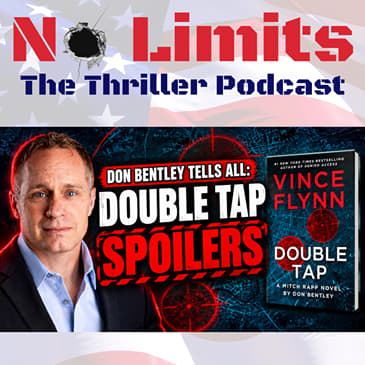
Don Bentley returns to No Limits: The Thriller Podcast for a full, spoiler-packed conversation about Double Tap, the latest Mitch Rapp thriller.
Warning: This episode contains major spoilers for Double Tap. Don and I go deep on the book’s biggest twists, the return of familiar characters, Mitch Rapp’s early evolution as an operative, the high-stakes deep-cover mission at the center of the story, and the choices that shape the novel’s ending.
We also discuss how Don approaches writing in Vince Flynn’s world, the pressure and responsibility of continuing the Mitch Rapp legacy, and what it means to revisit this pivotal stage of Rapp’s career with both longtime fans and new readers in mind.
In Double Tap, a young Mitch Rapp goes undercover to stop a jihadi cell after a Pakistani chemical-weapons scientist is kidnapped in Verona—an event that reignites old vendettas and threatens to push the Middle East toward crisis.
—
🔗 WATCH, LISTEN, & FOLLOW US:
Website → https://thrillerpod.com
YouTube → https://thrillerpod.com/youtube
Spotify → https://thrillerpod.com/spotify
Apple Podcasts → https://www.thrillerpod.com/apple
Instagram → https://thrillerpod.com/instagram
Twitter/X → https://thrillerpod.com/twitter
Facebook → https://thrillerpod.com/facebook
💬 JOIN OUR BOOK CLUB
Die-hard thriller fan? Join our Book Club on Patreon for exclusive discussions, behind-the-scenes insights, and 24/7 thriller conversation:
👉 https://thrillerpod.com/bookclub
📚 ABOUT NO LIMITS:
• The Mitch Rapp Podcast: Deep dives into Vince Flynn & Kyle Mills' Mitch Rapp series.
• The Scot Harvath Podcast: Exploring Brad Thor's high-octane Scot Harvath universe.
• The Thriller Podcast: Book reviews across the thriller genre: Jack Carr, Dan Brown, and more!
—
#MitchRapp #DonBentley #ThrillerPod #ThrillerBookReview
[00:00:08] And let's just do it now. Spoiler warning. Let's do it. All right. Are you kidding me? Donatella? Yeah. What? What? It's so good. Oh, my God. I didn't see that coming. I didn't see Israel coming. I didn't see Scott Coleman coming. I didn't see Donatella coming. How can you go to Italy and not have Donatella? Like how could you do that? Sure. There were these little hints that I was like, wait.
[00:00:38] Wait a minute. That woman sounds like, yeah, I know that she's been through some stuff. Here's my guest. Um, spoiler visit. Nice. Nice. No, it was super fun. Cause I was trying to, and I can't believe I can't remember. So Ben Friedman and Donatella are introduced together in the same book. And I can't for the life of me, remember which one it was, but I went back and tried to find Vince or I found Vince's description of her.
[00:01:06] And then what Chris is alluding to is I put that in, but then said like Mitch is looking at her and like, she, she, she could be on a fashion magazine or she, because, and just kind of slowly, hopefully laid the, so that the, again, what you're trying to do with all of these is make it accessible for somebody that picks up their first Mitch Rapp ever. But then to give people like y'all a little kick out of seeing a familiar character and make a new appearance. So yeah. Yeah. Possibly separation of power.
[00:01:36] Is it possible? It might have been somewhere around that time. Separation of power. Yeah. Yeah. Cause she's a little bit down the road that she comes in. Yeah. Yeah. And I'm guessing the timeline checks out in that. I know she got recruited by Ben because she was kind of in the dumps, you know, with the, you know, the life that she led before that. The model lifestyle. Yeah. Got a hold of her. Yeah, for sure. Yeah. That's an origin story. They're waiting to be told.
[00:02:03] If not in this book, I feel like that could be a spinoff that the people might enjoy, especially considering some of the antics later on with the, with the love triangle, if you will. I remember she comes home. Anna's been waiting all night for Mitch. He brings a ton of talent. He takes her to Italy. That's supposed to be their trip where he's going to propose to her. Oh, it's unreal. Comes back after visiting his hot former model, old Italian girlfriend, who's also an assassin.
[00:02:32] Mitch, what are you doing? Yeah. Yeah. What are you doing, guy? Minor stumble. Well, it's funny because that's some comedic relief that Vince put into it. And you were saying earlier, Scott Coleman, Kyle chose Scott Coleman to be that vehicle who would be a little bit more of the, you know, goofball at that stage in his life. He's seen a few things. He's seen a lot. So that made sense. Where do you get your inspiration for, for the comic relief? Man, that's a good question. Your books have been serious.
[00:03:01] I will say they've been a little bit more heavy and grounded. Like, you know, the Cold War era and the early war on terror. I think I try and do it in, in the, like the back and forth between like Hurley and Mitch or there's the way in this book, the way you, the lead in chapter to Hurley, the chapter before that is Irene is sitting there brief in Stan's field.
[00:03:30] And he said, well, what happened to Stan Hurley? And she's like, oh, he's, he's on a training mission. And he says something like, you should know there's no such thing as a training mission with Hurley. And then you get to see Hurley and that thing's going sideways. And so I don't, I don't know that I have a character that's a vehicle for it as much as I try and just kind of set stuff up to be inside jokes for the reader. Yeah. It makes sense. Hurley's mouth. I feel like just whatever comes out of his mouth is, is going to get a chuckle.
[00:04:00] It's going to get a spark. When I was, I meant to bring this up when you were talking about Hurley earlier, I can't remember if it was, I don't think it was Kyle. There was somebody else I was talking to that said that they, they loved Michael Keaton on it, but they pictured, and I can't remember who they pictured. I always pictured the guy that was the, the, the guy from Full Metal Jacket that was, um, passed away a while ago. Yeah. Yeah. Yeah. That's who I always think of. I could see it.
[00:04:30] Yeah. A little taller, but that's, yeah, yeah, yeah, yeah. I could see it. Yeah. You know, what about David Brown? You think he can play the, play the role? I don't, I don't think so. I don't think so. Put a mustache on him and just see. There's a part for him to play for sure, but I don't know if it's that one. Extra body being put into the, you know, uh, body bag, extra number five, body number five. Oh my God.
[00:05:01] Well, actually here's one for you. Someone in our group chat. And again, I'm privy to the spoiler group chat. Try to avoid it. Someone dropped a rod, Rob Ridley reference. Is that another little oldie, but goodie that might be hinted at? I don't think so. So somebody dropped that name and I was like, wait a minute. There's some Ridley in there. Is there? There's just a little bit of Ridley that comes in. Oh, yes. Yes, yes, yes, yes, yes. Yeah, there is a little bit. Sorry.
[00:05:31] We interviewed a guy, Rob Richer, who was the chief of the Near East division that, you know, which would be Mitch's job. Yeah, yeah. And, um, he was the first one when Vince went around basically knocking on doors, calling CIA and saying, Hey, just give me somebody. I'm an author. I want to talk to somebody. I want to get to know a spy. And they put it on his desk when he was early in his career. And he was the first CIA point of contact that Vince had and then became his main insider in CIA when he became Near East chief.
[00:05:58] Um, and we got to interview him and at a speech, I forget which one it was. Um, Vince gave a toast at some event and said to Rob Richer, who was the inspiration for Rob Ridley, because he's the one who taught me everything I know about the CIA. Yeah, that's amazing. I didn't even know that. Yeah. Yeah. The guy, um, and his name escapes me now, but the guy McCluskey, David McCluskey hooked
[00:06:25] me up with for, um, denied access was incredible. He had also been, um, uh, Near East division chief and had, I mean, just his office, you know, he had in one corner, it was like him standing on the freedom bridge where the Russians were pulling out and then another corner of him and the, the final director, the KGB with his arm around the guy's shoulder in Moscow, like just incredible.
[00:06:53] I think I spent, he, I think he was probably in his eighties now. Um, and he let me spend a hour, hour and a half at his home in his office, just asking him questions about what it was like in the cold war. And, you know, the difference between, uh, how the, the Russians did the KGB did things and we did things. And I remember asking about Moscow rules in which, um, poor Chris got to experience and
[00:07:21] denied access and asking him about that. And I, and I was like, was it real? And he's like, absolutely. And he's like, if one, if FBI agents rough, roughed up one of their guys in DC, they would grab one of our case officers and break his collarbone in Moscow. Yeah. Or something. And it was, it was a whole different thing back then for sure. Yeah. I remember you posted about him and I think his book and one of our, one of our patrons
[00:07:49] in the group chat read it and said like, yeah, this, this is incredible. This is a person who's lived a life. It was incredible. Yeah. So someone mentioned the ambassador scene. Uh, I don't know, Chris, if you remember this, uh, Mark wanted us to ask you about the ambassador's death and how you came up with that scene. Mark, Mark likes focusing on his favorite kills. So there must be something about an ambassador scene. He likes the gruesome stuff. He does that. He does. So the interrogation.
[00:08:16] So is that with, yeah, that, so Arab Gandalf and what was it? Oh, yeah, yeah, yeah. It wasn't an ambassador. He had me. Yeah, yeah, yeah. That you're, they're talking about in the mosque where the, um, where the three, yeah. Hezbollah guys were there. Yeah. That was the, one of my favorite Mitch rap scenes ever. And I'm terrible.
[00:08:41] Cause I keep forgetting the books, but do y'all, do y'all remember when, um, it might have been the last man, but when he's in Afghanistan and he walks in and, um, it is the, uh, an army colonel. And then this woman who I think is works for, for the state department or something like that.
[00:09:06] And he's trying to talk about what he needs and she's telling him about how he has messed up everything in Afghanistan and he's just, and he just raises his hand and she's like, do you have a question? And he's like, yes, now I know. And like, it's just such a great insight. Who's the idiot or something? Yeah, yeah, yeah, exactly. Like you opened your mouth and I knew you were an idiot. Yeah, she starts it off and she's like, do you think I'm an idiot? And he's like, I haven't made up my mind yet. And then he's like, now I've made up my eye and you are.
[00:09:35] And so I wanted to do something like that where Mitch is sitting there undercover and he's, he has to endure these three idiots who are also, you know, bad guys in a position to, to end his life. And he's sitting there and he finally gets to that point where Mitch gets to, in every good scene, he's like, all right, I'm done with this. Like I'm about to make stuff happen. And so it was a super fun scene to write. Just because that, that one was kind of my inspiration.
[00:10:03] Like that's one of my favorite all time Mitch scenes is he's just sitting there and he gets tired of this woman who has no idea what it actually means to run the war in Afghanistan, telling him what's what. And he's like, all right, we're done here. So yeah, that's a great pull. It's just like, like the three stooges basically trying to run a interrogation.
[00:10:26] And so Mitch gives them those names so that he can keep track of them for the reader. And it's just, it's fantastic. You need an interrogation scene. I feel like that's a hallmark, a hallmark of thrillers, but certainly of a Vince thriller too. Yeah. What about another hallmark of a Vince thriller? And I feel like you've pulled this off in a couple of your first rap books. For lack of a better term, like the congressional hearing scene, it may not be in Congress,
[00:10:55] but the boardroom scene, maybe that's a better term for it. And it doesn't always need to be Vince. I feel like we've seen Irene do it. We've seen Stansfield do it. But do we have any of the, one of those panels where somebody gets to mouth off to the powers that be? I'm sure there were a few superiors you would have liked to back in the day, say a few words to. I don't, can't remember if, so not from the American side. You do get to see one of the things.
[00:11:21] So the Ben Friedman is also in this book and you get to see him before he's the director of the Mossad. And so as I was, you know, part of what you're trying to do when you write these characters that come onto stage before Vince originally interviews them is just like we were talking about with Scott Coleman and Irene Kennedy. How do they get from point A to point B, right? If you, if you introduce them the same way Vince does, that's no fun for the reader, right? Because there's no growth, there's nothing different.
[00:11:50] So with Ben Friedman, I was trying to think like, who was this guy? Because Vince went to great lengths, almost given in the same kind of backstory that Daniel Silva's Gabriel Lon had, right? Like Ben Friedman was also one of the assassins that hunted down the Palestinian terrorists from the Black September and the Munich Olympics and stuff, right? And so how does that guy go from being kind of the Israeli, maybe partially kind of the
[00:12:17] Israeli equivalent of Mitch to being the director of the CIA, which is something that we can't, or at least I can't, can't imagine Mitch ever wanting to do, right? And so I have Friedman, like when the book starts, he's in a leadership position, like an executive leadership position in the Mossad for one of the first times. And there was, this was also a true story. There was a period in the late 80s to early 90s where the Mossad went through something
[00:12:46] like seven or eight different directors, like one after another, they kept getting fired. The Jonathan Pollard thing was part of it, some other missteps they did. And so you get to see Friedman trying to do the right thing for his guys and girls in the field. At the same time, the Mossad director at the time is very much a political animal who's only concerned about using his post in the Mossad as a jumping off point to serve in the Israeli Knesset.
[00:13:14] And so there is kind of one of those meetings where it's not Mitch or any of the Americans. It's actually Ben Friedman sitting with his boss and the Israeli prime minister. And he kind of has the opportunity of, do I tow the party line and back my boss up and leave my guys and girls in the field hanging out to dry? Or do I actually tell the truth and let the cards fall where they may?
[00:13:39] And he does this really fun scene where he kind of leads his boss down this path that he doesn't, his boss being, like I said, a political animal doesn't realize where Ben's taking him. That kind of gets him to the point where he can do right by the girls and guys in the field. I like that. But I feel like as much as I have a really bad, gross, slimy, like taste in my mouth about Ben, if I were one of his, his field agents, if I was out in the field, if I was batting
[00:14:09] on his team, I would want him, you know? Yeah. That's the guy you want going to the mat for you. But we always saw from the American perspective of how we do a slimy dealing and screw over Mitch or Irene or compromise our guys because he didn't care about our guys. Our guys were not his countrymen, his service members. Yeah. That's interesting. That's an interesting flip of the script. I like that. Can I ask a big one? And I know both of you guys know the answer, but what about the Rafiq Aziz of it all?
[00:14:38] I don't want to say I was disappointed, but knowing that we were following up Killshot, what happens that his name is dropped, right? He was, he was at the end of Killshot supposed to rendezvous with the guys in this meeting. Mitch slaughters them all, but he's still out there. You know, he's almost on the run and Mitch just has to figure out that's the guy he needs to find to get his revenge. Yeah. Do we move any, a few steps closer to this? I mean, you might, what do you think, Chris? Do you move a four? At least a hint.
[00:15:07] I mean, we might, we might move a couple of steps closer on this one. Okay. I think, I think it's, it's a good, it's a good move. I think it's a good move. That means there's another, that means we have not finished the timeline. Cause that's another thing in my mind, not having read it. Does this fill us in to transfer power? Are we ready for Aziz to storm the white house? Like, are we that close to it or, or is there still a time period here? I think there's still a time period.
[00:15:34] When I said, when I was originally going to write this one, I thought it would be the book that bridged the gap. And there's just, there was just so much story to tell. And I had like two competing things. Like the, the story I started telling. And in the back of my mind, I was like, okay, this has got to be the book that bridges the gap. It's got to be, that gets us there. And I felt like I was just forcing that in, that it wasn't that the story I started to write had taken on a life of its own.
[00:16:02] And you, you know, the last thing you would want to do, cause there's so many rich things there, right? There's, there's their history back and forth. There's even, you know, Mitch has a scar from him. There's even the scene in, I think in transfer of power where he talks about it, that he could have taken him out, but there was somebody in the way and he didn't pull the trigger. And now he's second guessing, not pulling the trigger.
[00:16:25] And to me like that, that is just too rich to try and shove it in to the book and tie a nice bow on it. So I'd say it moves, um, it moves all the pieces forward, but it certainly doesn't resolve it at the end of this book. Yeah, that makes sense. The last thing I would want is something so important as that scar to, to be rushed or to be an add-on that's not integral to the plot. Yeah. That's the last thing.
[00:16:55] And now Chris, you, you are a timeline with, I know you actually figured out the dates here. You should see Chris's spreadsheet. She, she's got a spreadsheet and it's impressive. That's what I do because I can't remember. I can't like, I have a, such a bad memory unless I sit and read every single one every year. Like, like, uh, Nick was a Nick on, on Twitter. It's just like, Oh yeah. He reads the entire series every year. Yeah. Every year.
[00:17:23] I was like, that is, you're good. Like, but Mark in our group reminded us like, Hey, term limits is actually in between what we're talking about now. Like double tap and transfer power. So we haven't really hit Scott in the term limits. And in my mind, I was always putting term limits like first, okay, Scott's up here. Cause Mitch isn't in it.
[00:17:52] And I was like, Whoa, wait a minute. That's a whole nother set. It's never converging that our players that can be players now as we go forward. And so that is the other reason. Well, of course, cause I'm always excited to see Scott and see what he's up to. But, um, and, and I love the character he was with the, um, uh, the Delta Elvis, Elvis
[00:18:22] was he just, he's a real guy. So he's a really good friend of mine. His call sign is Elvis. Um, his name is, uh, Jason beefly and he's, um, he's actually in, I think capture or kill. I made him the CIA paramilitary sniper. That's, um, that's taken the shot to camouflage, um, Mitch as he's coming into bin Laden's compound.
[00:18:48] But Jason, uh, is the real deal spent the majority of his, um, career in that unit. In fact, his first, he was a normal infantryman first, then was in the Ranger regiment and then, um, was in the unit. And his first operational assignment in the unit was, um, Gothic serpent, which was the Black Hawk down, um, mission.
[00:19:13] And so he's helped me, um, with tons of research actually introduced him to Jason or, uh, David McCluskey's helped, uh, McCluskey with research stuff. And so he, um, I talked in the, the way that, um, Elvis interacts with Scott Coleman. Some of that is, uh, me kind of poking fun at seals, but in real life, what they figured out was that, um, seal team six was really good at some things and Delta force was really
[00:19:43] good at some things. And what happened after September 11th is that they were, um, trying to use those units interchangeably. And so like, um, you know, having, uh, seal team six come and take over for Delta force in Afghanistan and rotating back and forth. And they figured out early on that it was advantageous to have a liaison program between those two organizations and, and bring seals, rotate them over to Delta force and take Delta force,
[00:20:11] um, assaulters and, and rotate them over to seal team six. Now, Jason, as far as I know, never did a tour of duty, um, with seal team six, but that was a common, um, practice. And I thought that would be a really fun to show is that a, especially back then before the war on terror, when, um, before Delta force and seal team six were used so interchangeably
[00:20:36] would be this Scott Coleman looking at this mission set and saying, my guys are really good at this part of it, but there's a gap there. And how would I fill that gap? And so I spent, I actually had a much more detailed, um, whole battle scene for that and everything. And it was just as much as I would have liked to put it in, it would have just taken away from, um, the book and the main importance of the book.
[00:21:03] And so I spent quite a bit of time, um, on the phone with Jason, figuring out how the two would integrate and how Delta force would do that mission and how their recon teams would work and stuff like that. And so you only see a tiny little fraction of it, um, in there, but it, it was, uh, I named that, that character after I used his call sign for it and, and kind of, um, got to see, you got to see some of that integration between in the special operations community.
[00:21:32] So, yeah, I love that part of it. I, I, I was honestly hoping for more, but I realized like Mitch is no part of that. He's, he's over here. Right. Yeah. But that could be, that could be a whole nother. Yeah. It'd be really fun. Quiet series. Right. That was so fun. And it'd be really fun too, to show like what we were talking about before, like what takes,
[00:21:59] um, Scott Coleman at the pinnacle of his career where he's, you know, the, the, the Eagle scouter or boy scout for lack of a better term and turns him into the person that we meet for transfer of power. Right. What happened to him, um, to do that, that would be really interesting too, for sure. Sure. Yeah. I love just giving that glimpse in there.
[00:22:28] He's such a favorite of the series that when you chose to go back in time to the American assassin timeline, even when the Vince books came out, it was kind of like, oh, I guess we can't have Scott here. Yeah. And there was always that kind of like feeling that, no, I guess he's just not part of the universe right now. And to think that you can, there's an opportunity to bring the two together. Yeah. Yeah. And he's still a seal. We want to see him doing stuff. Like, and he's so good with seal demolition company. He's so good with the interrogations. He's so good as a right hand man. Yeah.
[00:22:58] I want to see where he built those skills. If we believe he has them later on in the series, let's see where he got them, where it affected them. So yeah, for sure. Yeah. We did a little bit of a ambassador Q and a where we took questions from ambassadors, but we got another one. Someone was wondering in the chat, was the Israeli operation always double tap? And then the title you use it as title later, or did you get the title and think we can name the operation? I don't know what this question means, but tell us about where the title came from.
[00:23:27] Yeah. So the book title is double tap and book titles are finicky things like you always like, so for instance, denied access was when I gave it to him that the actual espionage lexicon term is denied area that you have denied area operations. And they're like, how about denied access instead? And so double tap, I can't remember what I had proposed and they came back and said double
[00:23:57] tap, which works good with kill shot, but has nothing to do with the book. And I kept saying, I'm like, why double tap? Like double tap, usually an assault or lexicon double tap is when you shoot somebody twice. And then Emily's like, no, but when they're blowing up boats and stuff now, they call it a double tap where they hit the boat once and then they hit it, the, you know, the drug boats or stuff like that to make sure that it's taken out action.
[00:24:26] I thought, oh, well, that's interesting. I hadn't thought about it that way. And then I had like when I was writing towards the end of the book, I had in mind this idea for this crazy climax where you have these, you know, these disparate timelines all come together and you have, you know, kind of the theme of the book is the Israelis and the Americans working at cross purposes, even if they don't realize they're working at cross
[00:24:53] purposes. And I'm like, what if I had, you know, this had Mitch there and Scott there and the Israelis there. And I talked to a guy that had a friend of mine that I grew up with was an F-16 pilot. And he put me in touch with his buddy. He was a graduate of kind of the air forces version of the top gun school and was an air F-16 and he talked me through a bunch of stuff.
[00:25:20] And then I have a friend, Shai, who is an IDF, Israeli IDF. And he talked me through a bunch of stuff. And so I had all of that and then thought, OK, if I'm going to do this operation, how would it actually work? And I'm like, well, there would be two strikes. And then I was like, double tap. It would be a double tap. And so then it's so I wish I could tell you that it was all planned in that from the beginning, you knew.
[00:25:46] But a lot of times it works that way, that titles and stuff isn't or even, you know, I had some funny conversations with the Andrews and Wilson guys about covers. And sometimes the editor or the publisher will throw something on the cover that isn't in the book at all. And they're like, can you put it in the book? And you're like, no. But then when you do, it fits and it makes it even better. And so I think so the title was there before I had even finished the book and then, you
[00:26:16] know, had an idea of maybe how it could all fit. And I think it ended up coming together pretty nicely. Yeah. Crazy. The last 50, 60 pages, Mike, you're going to you're not even going to blink. Yeah, it is nonstop action. It is so great because you're just thinking like what what is going to happen? And at the very, very beginning.
[00:26:43] So we start off with these with these two young men in Iraq. And you lead them like you weave them in through the book so that they end up at the end. The Kurds. Yeah. So these Kurds, through circumstances, you know, are in the end too. Do you did you think of the ending first?
[00:27:12] And then you're like, I want to give I want to show the reason like these Kurds would be there, what they saw and that they're doing this. Yeah. Yeah. Yeah. So it's interesting when I'm a kid of the 80s. And so I was old enough to remember when it was George H.W. Bush that encouraged the Kurds to revolt. And they did. And then we hung them out to dry.
[00:27:42] And I remember seeing like the footage of it, of these guys on the mountaintop and some reporter being there and the Kurds looking at him and like, no, the Americans will come. The Americans will come. And we didn't. And like that, that image, like even from as a kid was like seared in my mind.
[00:28:00] And so when I started to write this book, I had the idea of like what would happen if, you know, there were two, you know, not kids, but, you know, young adults or whatever. And their dad or their tribe had pushed them out and said, we have a feeling this isn't going to go sideways or it isn't going to go well.
[00:28:23] Let's invent a job for these two to keep them out of Harn's way in case the Americans didn't show up. And then they watched this happen. And so I wrote that prologue and then and had an idea when I was first starting, I thought that maybe the antagonist was going to be one of these Kurds and they'd been radicalized and everything. And the story took a different direction.
[00:28:50] And so for a while, I just completely shelved the prologue, but I kept coming back to it. And I'm like, man, that was that, you know, just like I said, that image just stuck with me. And I think there's a place for them. And then as the story matured, I figured out how I could bring them back and then still have that play out somewhat.
[00:29:11] So not certainly not that they end up being the antagonist, but that it influences some of the choices they make, which makes things more complicated. And then maybe, you know, in a good book, what you want is a shot of redemption, right? Like a shot to to right wrongs. And so if you have the prologue lays out, you know, from their perspective, this horrible wrong that they did what they thought the American president was kind of like the Bay of Pigs, right?
[00:29:40] Like they did what they thought the American president was asking him to do and they left them out. And maybe there's a way that we can make that right by the end of the book. And so you get to see that a little bit, that maybe the the the one of the two Kurds realizes that he's made some bad choices, but maybe they have the ability and Mitch can make things right. When when America abandoned them once before. Yeah. Yeah. Yeah.
[00:30:09] Where presidents fail, there's always a trap. There's always a trap. Multiple administrations fail. We still need a trap. Yeah, absolutely. That's a great story about the Kurds. I'm excited to read that now knowing that. Yeah, you get you got to bring in you have to bring in things that really happen because we know now they happen.
[00:30:31] Unless you can tell the future like Kyle could, you know, total power and all that crazy stuff. But that was really good. It's just I love seeing that because you you kind of get invested in these characters that see these things happen. Yep. And then they they come back around and you see what happens to them. And I like that they they don't just disappear. I like that.
[00:30:59] That you did keep them in the beginning and then in the end and we see what happens to them. So. Yeah. Yeah. I also love how you were willing to adjust and be flexible as you wrote that scene, maybe shelving it, maybe tabling it. Yeah. And definitely not going with the typical storyline that's been done of somebody saw violence, saw the American flag on the shrapnel or bomb. They killed their loved ones. They get radicalized. They go join a cell and they become a cartoon from there on out. You know, they just become someone to be slaughtered. Right.
[00:31:29] I feel like the Kurds are the perfect group of people tell that story, the history of America. And some might say still ongoing thinking of the pullout, the Yazidis, you know, that whole region of just what is what does America's responsibility look like? If we've already learned we're not going to nation build, we're not going to be the world's policemen. Yeah. Does that mean you give up on all responsibility for innocent lives and entire cultures that might be eliminated? Wow. Yeah. I have the quote right in the book.
[00:31:59] I can't remember exactly how it goes now, but there's something like the Kurds have no friends, but the mountains or something like that. And that I thought about that a lot as I was writing it to you, like this, this, um, just this, um, very clear eyed way of looking at the world that looking at the U S involvement in the world of, um, what does it mean to be our friend now? And what does that mean tomorrow?
[00:32:27] And, you know, how do you be clear eyed about that and say, yep, we have American help now. We might not have American help tomorrow or next week. And so what does that mean for us as a people? It's kind of the same thing. Like I said, what, where we started in the beginning about, um, when Israeli and American interests, um, divert or, you know, branch off. And what does that mean?
[00:32:51] It means that at the end of the day, you have to do, um, what is right for the people that you represent, right? That in some way there's a theory for it that escapes me, uh, right now, but basically that the best thing a group of people can do is do what is best for that group of people. Because that's easier to, um, maintain alliances with, to do all of that.
[00:33:19] If you're like, we're going to look out for this group of people that we belong to, that we're supposed to represent their interests as opposed to trying to figure out, you know, what, what that looks like from entangling alliances and stuff like that. And you see that, like, you see that just that very cold eyed practicality. Uh, we have no friends, but the mountains. Yeah. Yeah. It's a great saying to bring it back to the cover. You mentioned some cover talk.
[00:33:48] I remember when this thing dropped, uh, Chris podcast host, Chris and I, we did a deep dive trying to figure out this city. Do we get a double tap strike here with these, with these two targets? Where is the city? I, I think it's in Iraq and I'm not sure if, um, it might be Baghdad or something. The, when originally they were doing, um, I gave them some different ideas for the cover that they didn't like. And they're like, what about this?
[00:34:17] We'll do these. And you can't, um, you can't, you know, where the double, double tap happens is this stretch of road. That's, um, west of Baghdad that's along by the Syrian border and stuff. And you can't, if you, if you show that there'd be nothing there. It's empty. Yeah, exactly. And so that's a little bit of creative license with the, with the cover for sure. I do like to hear though, there is a double tap and it is along a road, you know, cause we see the road so highlighted.
[00:34:47] But Chris and I were looking at the shape of the river. We were looking at the actual shape of the river, like a town square or is this industry? And, and we couldn't nail it down. So one thing we do on the pod is we judge a cover by the book. A cover only gets our approval. If it one is designed really well, which this one is absolutely love the color scheme, uh, the targets, the target inside the U of double. It's, it's, it's brilliant design. We're like, what's going to be the icing on the cake is if there's actually a double tap strike.
[00:35:16] If, if it is somewhere where in a city that plausibly would have a map like this. And if it's isolated, you can't put that on the cover. So that's a, that's a reasonable change up. That's fair. Nice. Wow. Don, thank you. As we've said before, for keeping the series alive people, people like Chris here and I, we live for this every year. This is, this is a season to us.
[00:35:41] It's the Mitch Rapp season, getting ready for ambassadors and arcs and eventual publication in September. So you're the reason, you're the reason it can keep happening. So thank you. It's my pleasure. Like I said, this is the best job in the world. So I'm still, uh, still pinching myself. I get to tell stories in Mitch, in Vince's universe for sure. Can you share any, any more about the future?
[00:36:11] There, what I can share is that there is a future and I am working on it, but that, that is all that I can share. All right. Okay. Okay. Well, that's, that's, she's like, I'll take that. And then once you have a couple of beers in you in Minneapolis, I'm going to ask more questions. Okay. I was scared to ask, but I'm okay. I'm very excited.
[00:36:37] Cause I was like, cause this is the time when he starts doing interviews that he starts to drop a little bit about what he's working. Nothing, nothing. Lips are sealed. Okay. Chris, when he spills the beans in Minneapolis, I expect to text about how long the contract is. She's going to be under the table texting people. No, we need Matt Drake and Frodo though. We need an update. Matt Drake, Frodo. Are they in your mind? What's going on?
[00:37:01] Uh, so the, um, I guess last year, this time I got to write two versions of the pilot. It finally went out to buyers maybe six weeks ago. And so I think half of the, yeah, everything. The only thing I know about Hollywood is it moves slow. That is the only thing I can say it moves slow.
[00:37:30] So about half of them have passed. And so I think that there are five left that are still working on it or still looking at it. I don't know. I don't know what that means or how to handicap it or, um, to tell you other than it moves slow. And it's kind of fun that buyers are looking at it. So we'll see. You see yourself writing books down the road ever again, or? Yeah, I would like to.
[00:37:57] I think, um, this genre is a really hard one right now. And they're most everybody is either doing, um, spinoff books like what, um, Brad Thor and Ward are doing or like Jack Carr and Mike Woodward, or they're writing standalone books that are adjacent maybe to the genre, but not in it.
[00:38:21] So I am finally buckled down on the standalone I've been working on forever. I'm going to finish it this year and then, um, hopefully take it out the beginning of next year. And then we'll see. I do have something. I can't say what it is, um, yet, but I do have something that's just under my name. That'll be released this year. So it'll be released in November.
[00:38:46] And so as soon as they done final edits for it and stuff, as soon as, um, the publisher gives me the thumbs up, I'll be able to talk about it. So you do get something from me this year, but it's not a Matt and Frodo book. Okay. So I can't imagine juggling something like that and Mitch Rapp at the same time. So I'm glad, I'm glad to hear Mitch Rapp is continuing. Mitch comes first for everything. So Mitch words always come first. I write his words first in the morning and then work on my side projects in the afternoon.
[00:39:16] So happy to hear it. I think, uh, Scott Elvis novella. Sure. Just a couple, couple like origin stories in the romance genre. Chris is what she really saying is. I mean, that's another question, right? Like why, why is Scott Coleman not married? Like what happened to him? He must be broken.
[00:39:45] He must have a girl out there somewhere that broke his heart. He's a free spirit, man. Yeah. I mean, I'm just dreaming about that girl on the tractor in total power. I still remember that. Like I said, the last book I read was, um, code red and just seeing him with Anna is so funny.
[00:40:11] Like Kyle does such a good job with the two of them and how she's bossing him around and getting him to do stuff. And, uh, like Kyle just does that. So well. And he doesn't, and Kyle doesn't even have kids. That's what kills me. Like, I feel like he writes Anna, um, just perfectly. And he doesn't even have kids. So true. I love everything he did with that storyline. Yeah. With the family stuff. Absolutely. Love it. Yeah. That's cool. Thanks, Don. Thanks, Chris. Yeah. Filling in for Chris and Don. Thanks for doing what you do. Appreciate.
[00:40:41] Absolutely. Looking forward to seeing you in a couple of weeks, Chris. Yeah. We'll see ya. Sounds great.