
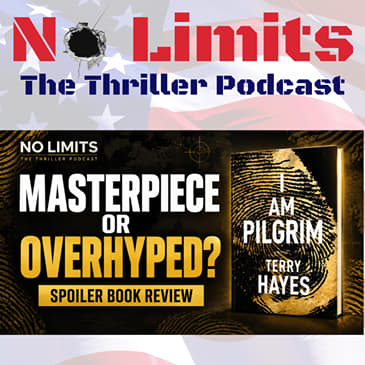
Is I Am Pilgrim by Terry Hayes a masterpiece—or overhyped? On No Limits: The Thriller Podcast, we dig into the twists, characters, and ending, debating what works, what doesn’t, and whether it lives up to the hype.
⚠️ Spoiler warning: We discuss the full book, including the ending.
Masterpiece or overhyped? Drop your verdict in the comments, and subscribe for more thriller book reviews.
—
🔗 WATCH, LISTEN, & FOLLOW US:
Website → https://thrillerpod.com
YouTube → https://thrillerpod.com/youtube
Spotify → https://thrillerpod.com/spotify
Apple Podcasts → https://www.thrillerpod.com/apple
Instagram → https://thrillerpod.com/instagram
Twitter/X → https://thrillerpod.com/twitter
Facebook → https://thrillerpod.com/facebook
💬 JOIN OUR BOOK CLUB
Die-hard thriller fan? Join our Book Club on Patreon for exclusive discussions, behind-the-scenes insights, and 24/7 thriller conversation:
👉 https://thrillerpod.com/bookclub
📚 ABOUT NO LIMITS:
• The Mitch Rapp Podcast: Deep dives into Vince Flynn & Kyle Mills' Mitch Rapp series.
• The Scot Harvath Podcast: Exploring Brad Thor's high-octane Scot Harvath universe.
• The Thriller Podcast: Book reviews across the thriller genre: Jack Carr, Dan Brown, and more!
—
#TerryHayes #IAmPilgrim #ThrillerPod #ThrillerBookReview
[00:00:09] Hey guys, I'm Chris. And I'm Mike. And welcome back to this week's No Limits, The Thriller Podcast. What's new this week, Mike? Summer's winding down. Don't want to get too sad about that because it's been a very good one. But I think this is a great book to wrap up the summer with. We're kind of ending on a high note here. Yeah, yeah. No, it's always sad around this time of year when, you know, the kids are, I'm forcing them to do their summer stuff because, you know, before you know it's a good book.
[00:00:39] They're going to be back. But yeah, no, this was a good book. It was actually, it's been nominated how many times in a row by Sherry, our faithful. Finally got to do it. I unfortunately couldn't make the pod book club where we discuss this book because my daughter made championships for swimming. But I heard it was a banger, man. Like you had two people that went on over three hours. Like,
[00:01:09] come on. Yeah, I can see why I could see why they wanted to keep on talking. It was a great discussion. One of the best hangouts we've had with our patrons in the Patreon Thriller Pod book club. If you want to find out more about how you can help support the podcast, just head to thrillerpod.com. Click the get involved tab and look into our book club. But yeah, the hangout was so much fun. And let me tell you, there were some hot takes going on. I have my own, which was not very well received by the group.
[00:01:37] All right. I quickly became the outcast, but I will say people were loving it. It's the number one book so far in the book club that people all agreed about, that people loved, that almost everybody rated the top of the top. And Mark went so far as to say easily his top five favorite book of all time and possibly in the number two spot.
[00:02:27] Wow. Everyone is listening to me. So I'm, I'm getting now other book Instagram accounts, like people that give book recommendations. It's funny that I guess, spoiler there. We were definitely going to cover. What is, what is the one everyone's now talking about? Like cat, someone with a cat.
[00:02:45] Oh, this dungeon crawler, Carl business dungeon crawl. So before you guys even talked about it, maybe it's because like my phone, like knew that group me was already talking about it. Like I was just getting push, push, push. And I bring, I say all this because at the same time, when I'm listening to I Am Pilgrim, I'm getting pushed. Like all these, I Am Pilgrim stuff.
[00:03:04] So, um, I really think, um, I really think I'm, I'm going to go out on a limb here. I'm with Mark. This is honestly one of my top five books of all time. Wow. I loved it. I don't know if it's, I love the audio book too. Like it's, and it's, it's a, it's a behemoth of a book, but it's so, so propulsive.
[00:03:30] Like it is the type of book that makes you want to, you know, you sneak out of bed at night. Like once your wife goes to bed and you like, you know, turn on a little flashlight so you can keep reading because you need to know what the hell is going on. Um, now I do have some critiques where I'm always going to have critiques, but to me, the writing in this is like next level. Um, you can definitely tell that, you know, he, a passion for the craft.
[00:03:57] Um, extensive research, uh, you know, but to me that this is an espionage book that is on the level of LA career of on the level of, you know, Tinker, Taylor soldier spy ask, but like way more propulsive and way more interesting, you know? Like, uh, so I don't know, but what's give us your hot take. I gave my hot take. Give me, give me your hot take.
[00:04:23] No, sure. I just respond to a few of your points. I absolutely agree on almost everything there. I don't know the story behind the story of how Terry Hayes came to write this book. And I didn't even know he was a screenwriter beforehand. And they mentioned that in the book club. Uh, and I think some people knew of some of his films, some of the things that he's written before. Uh, so somewhere like really impressed that he did a couple of things they recognized. So something about that makes him an excellent storyteller. The way he can craft the sentence.
[00:04:53] Oh, Mad Max. He's, he's a screenwriter on, on Mad Max one and Mad Max two. Oh. And then brought back in for Fury Road. So like, no, I, I, and planet, he, he helped, uh, write Planet of the Apes and Return of the Apes. So he's like, you know, very accomplished screenwriter. Oh, he's been around. Cause I kind of think of this as a debut novel in the thriller space or espionage space. It is his debut novel.
[00:05:15] But that makes it all the more impressive, right? This is the first time you're writing a full length novel, a full, full length novel. Let me tell you. Um, and to pull that off, yeah, hats off. Once you hear he's already an established writer, it just kind of makes sense. It kind of clicks because the writing is that strong. The command of the English language is that strong.
[00:05:32] The way you can shape a sentence to be a masterpiece that fits inside a paragraph in the perfect, you know, place with perfect pacing, which fits inside a chapter, which is like just the right length to really go deep enough into world building. That, that was one of my takes on the book club is there are multiple acts to this book. And I really like shifting between them. And it's unfortunate because some of them, even after spending, I don't know, 50 plus pages, maybe even a hundred plus pages.
[00:06:00] For example, with the Saracen's origin story, him as a kid, seeing his father, hearing about the zoologist and this public execution in Saudi Arabia. I could have lived in that world forever. It was so masterfully done to build that universe, bring you into it, have people and storylines that are, they wet your whistle so much. You need to know where they're going.
[00:06:25] And yet he's equally holding something back. So I think Terry is just a master playing this game of what the audience needs to know and when, and how he's going to reveal that. And another next level thing with the writing is the perspective, how all of this is told from the main character's perspective after the fact, right? Right. It's really a retelling. It's a memoir. It's a memoir. Yeah. It's a memoir, which I thought was going to dabble into that. We've talked about it before that unreliable narrator piece.
[00:06:53] So I was wondering if some of the cockiness and the, you know, pumping your own tires was going to fall flat. Like, is this guy as good as he's leading us to believe? Is that all him just recounting it? You know, is he really a little bit of it, but I think he does show the goods in the end. Correct. Correct. The shoe never drops. Right. So it's not actually that trope. It's he kind of was that good, but he's also along the way admitting his, his faults, like where he missed something or was like, I should have noticed this, or I didn't realize this would have such a big impact.
[00:07:22] And it's just kind of really drew you in with that creative perspective on the storytelling. So all that absolutely agree with you. There's a few things. And I only say this looking back at the end during the book I was bought in. So the buy-in score is really high reading this. I put it off like many others because of how long it is. It might be the longest book I've ever read, to be honest with you. That's very possible. I think if you wouldn't.
[00:07:52] Lord of the Rings aren't longer than this? I mean, together, because they are supposed to be one book. Or the Game of Thrones. Did you read those? I never actually read a Game of Thrones. Yeah. No, but Lord of the Rings, I think each of the three different books, I don't think. It's not that big. Would be as long. Maybe. This is like, what, 800 pages? Return of the King. But yeah, together, obviously, they would be. But that was a reason I put it off for a little while. I knew how good it was. I knew people were recommending it. I saw the praise online.
[00:08:19] Something about that block of, I'm going to have to be in this for too long. But I was happy to be in it. I think I finished it in three days, the audiobook, on three speed. I wanted to listen to every minute that I could. Didn't want to stop. Yes, I'm the crazy person who listens on three speed. I understand. But my one thing that took me out of it, in the end, is the convenience of it all.
[00:08:41] The fact that everything lined up perfectly, and there was so much seemingly coincidental overlap between these different storylines. I was led to believe that he's so good. He put the pieces together. He made the connections. And he kind of forced, you know, by sheer willpower and creative thinking and lateral thinking, he put the pieces together. And part of me was like, no, he just kind of fell into Layla's hands.
[00:09:11] Like, they just, their paths just crossed. And then the way also the Dodge story, right? She's involved in the Dodge story. And, like, it happened to be this guy in Turkey. Almost everything in the end, I look back on it, it just seemed like it had to happen as plot armor. Because if any of these things didn't coincidentally fit, if the pieces didn't fit, there's no way we're tracking him down. And I didn't feel like he was that mastermind fitting the pieces together with these little things that he found enough.
[00:09:39] And it ended up being, we just got lucky that this story related to this story related to this story. I don't know if that's a fault of me as the reader not getting it. Perhaps a fault of staying inside his head the whole time. But what I proposed to the book club was, objectively, the way this murder conspiracy plot went down. From everything with the woman in New York, reading his book, using his book, going to Bodrum, finding the old man.
[00:10:05] And then the Whisperer and the CIA just happened to use the old man Dodge's murder as the cover story to get him in there. And then Layla happened to be the one assigned to this case. And then he happens to be building a relationship and rapport with her as a distraction. And then she happens to be the Saracen sister. And then just over and over again, I was like, is all that plot armor that it just has to come together this way?
[00:10:29] If you objectively say that murder took place and all these connections happened, would you buy it as much? If objectively, without being inside this guy's head of him retelling us how he got there, how he put the pieces together. From that outsider perspective, I'd call bullshit. I'd be like, that's just ridiculous how all this is happening and it's all just coming together. Being inside his mind, he's able to like lead us along and make us kind of believe that it actually all makes sense that it overlaps.
[00:10:57] But from an objective outsider viewpoint. Yeah, I think, you know, you could ask the question, did the coincidences break you from the immersion that you were put into it? You know, in the moment, no. Or or did the pace and the tension make you willing to like. Have that suspension of disbelief, you know, it did. No, it did. I'm completely giving it its shout on kudos and the writing and doing all the things to keep the reader involved. This critique is solely after finishing the book.
[00:11:26] And I'm like, my mind is blown that everything connected so well that every T was crossed. Every I was dotted. Everything checked out. You could sit there and analyze. And I don't think you'll find a plot hole. I don't think there's a mistake made anywhere along the way of something that doesn't fit. But then I was like, wait, why does the puzzle come together so nicely? Oh, because the puzzle has to come together so nicely or we don't have a story. Yeah, I think it's like it's sort of like a chicken and the egg thing. Like, yeah, yeah.
[00:11:54] If it wasn't so, you know, we've read thrillers where the improbable premises that it's built on are like so disbelievable that it leads the story to break down even while you're reading it. Yeah. Whereas this case, I just felt that the mastery of the interconnection is just, I don't know, it made everything fit together. Like it worked. It worked for me.
[00:12:21] And I will say, like upon reflection after the novel, you know, when you're, you know, if you want to mince, you know, mince not mince words, but like, you know, really dig into it. Sure. Like the fact that it's coincidence that that's his sister, that the police chief happened to be his sister. It's pure coincidence that it happens to be this person decides to, you know, commit a murder based solely on his book.
[00:12:46] And he happens to be in New York, you know, to be brought into this case. And then he happens to use this case and doesn't even realize that it's related to this other murder that he happens to like use it as a false. I thought that was my biggest stretch is the fact of using this random Dodge murder to be his, you know, his cover or like his, um, his knock, right. How he's going into the, and then, then that is also connected. Sure.
[00:13:16] But the way it connected and like the, the various things were going on with, you know, like the, the film developing the, the mirrors like in Venice to like, you know, I guess just the trade craft and like the interconnectedness that he puts and builds into this system. Sure. It makes sense that this guy who is fricking the world's best, uh, spy slash investigator. Of course he wrote a book and of course someone's going to read it and want to like craft the perfect murder from it.
[00:13:45] Like, uh, you know, to me, like, I guess it just shows the testament of how well Hayes built art, like my trust in the reading, like through the language that I was able to suspend my disbelief and go with it. And, and I guess I enjoyed the ride so much that I'm willing to like, accept it. Yeah. I'll agree with you. I was the same way as I was reading it. The one moment and kind of backs up my point. So I'm not going to disagree with anything, but the one thing that backs up my point is the one moment I was taking, there were two moments I was taking.
[00:14:15] I was taking that story. But one of them was when we were finding out that Layla Kamali is the caretaker for the child and that she's the sister in my mind. I'm like, no, no, no, no, please don't make it her. Please don't make it her. Cause I was like, if she's the sister, it's just too easy. I'm like, if, if, if she is indeed the sister that we saw in the beginning. She was the wife in the beginning, I thought she was the wife that like quote unquote died. Yeah. You know, I thought, I thought that as a possibility.
[00:14:41] And in my mind, I'm like, please just, it will just be too after so many happenstances that I was already like, okay, he's going to Bodrum. He has history with Bodrum. Okay. This thing in New York, she's got his book, Ben Bradley founded him. He's the author of the book. Um, she's in Bodrum. The, the, I'm just like the killer is the one in Bodrum on the Dodge case who was also the murderer of the original New York thing. Wait a minute. This is like, it's working for a story and keeping me moving and invested.
[00:15:09] But one more thing is going to tip me over the edge of it's just too easy and happenstance to write. It's all connected because of blank. And then when she was the sister, I was like, it's all connected because Layla Kamali is actually the sister of the Sarasota. I'm like, shit, that was one too many. Like the straw that broke the camel's back because I wanted that revealed to be this amazing thing. Like, oh my God, cover your mouth. Oh, I can't believe it. And it could be that if you're not thinking too hard, but maybe I was overanalyzing it.
[00:15:36] So I think it's just the nature of like us and like, you know, this podcast and how we think about books. It's true. It's true. To me, like the other thing that I, you know, could, if I needed to pick a knit is. And it comes down to like, do you believe in this idea that Hayes tries to play is this idea that love conquers all.
[00:15:57] And this idea that some guy who devoted his entire life to developing something to bring down the West that would ultimately bring down the people that killed his father. Yeah. He would give that up because he is a father. Like, do you, do you believe that? One of my favorite moves in the entire book was that. Yeah. You texted me that, that kind of, you're like, really?
[00:16:26] Wouldn't he just sacrifice his son? Like he's sacrificing so many other people. I was like, hell no. I'm like asking, like, it's a good question. Like, like. No, it is. Yeah. I would agree with you. I think like he, the guy did enough. Terry's did enough to build up that character. And yes, he's super evil, but it's almost like his, a modicum of a redemption arc in the sense of. A hundred percent. A hundred percent. You know, he's, everyone's human.
[00:16:52] And then like, you know, everyone can have that one thing that you're going to give up anything, even if it's your entire life's work to save. And Scott, the main character, if we can call him Scott. Yeah. Well, he's so many names. I don't know. Yeah, exactly. He did. He bet the farm that the Saracen would make that choice. And a lot of people would discount that and be like, no, he's a crazy, radicalized, evil, you know, Islamist, terrorist, whatever. Like he's so far gone.
[00:17:21] He wouldn't even care about family like that. Scott knew him. Scott, like part of his, him being so good at the forensics was having to do that profiling. That's psychological profiling. And instead of everybody else in the intelligence business who would be like evil, terrorist, mastermind, you know, jihadi wants to go get the virgins in heaven, like he's going to do whatever to blow people up and end this whole thing. And Scott was like, no, no. Underneath all of that is a man. Underneath all that is a little boy whose father was taken from him.
[00:17:51] Underneath that is somebody who loves his family so desperately that he went on this radicalization journey because he loved his family so much. And you can use that. Right. And that's the only leverage you might end up having, which I think was also a fantastic line towards the end to cap that plot off. When Ben asked him, would you have done it? Or he has been. Oh, I was just about to bring that up. I was about to bring that up. And Scott was like, that's what makes me and you different. And that's why I put you in that place because you wouldn't have done it.
[00:18:21] I would have done it. And I believe Scott as well. I 100% believe him. I do 100% believe that. 100%. Great line. That was a great line. It comes down, you know, it's very similar to another book we read where The Terminalist, where she goes, how did you know he wasn't like that? You're going to blow me up. You're going to blow me up. It's like you just know.
[00:18:44] You do the work to mentally profile, you know, to understand a killer and to get that leverage. Some of the best like Criminal Minds episode is where, you know, the various profilers are like figuring out. They find that one thing that, you know, makes everyone human. And he picked up on it early when Layla shielded the kid at the park or like made some little move about it.
[00:19:14] And so he's thinking family runs deep to these people. There's something beyond what meets the eye. Similarly, how he knew it was a woman, the killer in the hotel room. There was something like beyond the usual line of reasoning and like usual intelligence. Like it was too neat. It was too neat. What was thrown in the garbage? Who puts the milk in the fridge? The milk in the fridge. In a beer. Exactly. Exactly.
[00:19:39] Like little tells like that I was bought into that this guy is as good as we're led to believe. And I think that culminates with him getting the drop on the Saracen and really understanding we have to meet the Saracen. We don't have to defeat the Saracen. The only way we win is if we meet the Saracen. And so I believe that there's a redemption arc. I believe that he would have given Kamali the gun at the end and trusted her and said, look, like you, we have to work together now to get out of this whole shootout.
[00:20:08] And it wouldn't have worked if he didn't play that angle. I also like the, the vulnerability that Hayes gives Scott. Like, even though he is this sort of too perfect of a character in a sense where he's, you know, almighty, you know, he's the right. He's the guy who killed the writer of the blue, like to become the writer of the blue.
[00:20:32] He he's the one who's retired at age 30, like, because he's already, you know, he's so burnt out from having done all this stuff. But in the end, it's family he wanted. And then he realizes that he pushed himself away because he thought that, like, they didn't want him or like whatever. You know, he has his obviously his PTSD from his mom's death. Yeah. But then he realizes at the very end that he actually did like Bill loved him and he loved Bill.
[00:21:00] Like, you know, they had that connection. And then I love the fact that you bring it all around to, he goes on the sailboat and he says, I did die there, but it's, it's not like my body dying. It's like my, you know, I'm, I'm stripping away all of this emotion, all of this baggage. And I'm now, I'm not going to be able to go back and be refreshed and get back, you know, in this.
[00:21:23] I love the little tidbit of, you know, Bill leaves him all this, these crazy paintings when he bought Warhol and he was like, you know, a starving artist. And now it's worth millions of dollars built, you know, almost half a billion dollars. And he donates it and he says, you know, to Bill from your loving son, Scott, like that was just a nice touch. Yeah, it really was. A lot of those touches were really nice. And a lot of the backstories were so good.
[00:21:50] The Saracen one, I think was really good, but the best backstory was Ben Bradley. Oh yes. Oh yes. The same way I could have lived in Saudi Arabia, hearing all about the Saracens. I want a complete 9-11 story. I wanted more of the 9-11. I wanted more of Ben Bradley and him figuring out who wrote the book, right? And tracking down the Scott. I love just hearing the retelling of that. I think he was a fantastic character. And I loved how, I wasn't sure what role he was going to play. I loved how he was needed.
[00:22:18] Because another moment I questioned was when he was being brought into Turkey. I was like, I don't know what he's exactly going to do here. But it was perfect that he had to be the, you know, the hostage taker. He had to be, you know, playing that side of things. I didn't want him to like jump into action or start investigating. He basically just needed to be the wingman and he needed to trust Scott. Yeah. You know, he was brought in as like the only guy that Scott could trust. Could trust.
[00:22:46] But also, you know, didn't, he knew that he couldn't give him all the information that he needed. And he had to be willing to trust Scott. And ultimately he did. Right. So. Yeah. Like we were saying with trust is in the end, you needed Kamali to trust him and they had to trust each other. The CIA trust is a huge thing in this novel. You needed Bradley to trust him in the moment. You even needed the president with the whisper, the CIA great character as well. Oh yeah. The whisper and the president.
[00:23:12] You needed them to both trust him because when he calls in with I am Pilgrim, which was a great, a very nice title drop. And very light, very gentle. I wasn't sure how heavy they were going to play the code name Pilgrim. And the fact that he just dropped it once when he had no other cards to play. No other way to, that was his only way to get to the president. Yeah, exactly. And the president gave him some time, right? Gave him, what was it? 24 hours, 48 hours, whatever. 34 hours on that. Yeah. There's a lot of trust as a theme of this.
[00:23:39] And I think it's not trust on just like a whimsy. I'm going to take a bet on you. It's trust that's based on years and years of relationships, years and years of work ethic and knowing, you know, what you're capable of, what you've done in the past and who you are at your core. And once you reach those levels of trust, you can do big things. Yeah. Yeah. The whisperer, you know, it's like elements of a, why am I blanking on the old man?
[00:24:07] Stan Hurley, the old man, you know, all these like, quote unquote, secondary father figures that have, obviously they butt heads. Right. And, and in a way he even says like, I envy you in, in how one, you can still do all this stuff because you're younger, but two, you know, he knows that the pilgrim even says it like you are better than me. And I know you are better. You are the only one that I can get to do this.
[00:24:35] That's rare how the story is told of the old man, the boss. They usually want to hold on to their authority, their dominance. They want to hold on to being the ones who were at the top of their game. They need to be that mentor figure and know they're the best. The whisperer very clearly checks that ego and says like, I knew very early when I saw this guy, I knew I wasn't the best. Yeah. I needed it. He called him in. He called in Scott Pilgrim.
[00:24:57] All of these minor characters that are not minor, but secondary characters that Hayes builds, Bradley, his wife, Layla, the whisperer, the president. They're, they're awesome. Like even like the, uh, the villain work with the Saracen, like I love spending, we spend a decent amount of time alone with him. You know, we weren't, yes, we were in Scott's head, but it was like, like you said, it was a postmortem. It was a debrief.
[00:25:26] So he had already essentially, he was like recapitulating all this information that he had compiled after the fact and to give it to us, to lay out this, um, you know, this perfect formation of a villain was just, you know, compelling, compulsive. Um, I don't know. And it really like elevated the story for me. I 100% agree. I've been, we've been clamoring on the podcast for a villain this good. Yes. Yes. It's one of the best of all time.
[00:25:52] Um, the Saracen, everything from his childhood in Saudi, his radicalization in where Afghanistan and others. Well, it started in, um, Bahrain at the mosque and then it moved. Right. Bahrain getting recruited in Bahrain when his family was. Yeah. Became a moosh. Was shot down like three, uh, helicopters. Right? Yeah. Yeah. Yeah. No, all of that I loved.
[00:26:18] And then even the cover story as a doctor, like having to go into the medical field, learning the science, getting the supplies, eventually getting into the German company. I just think all of that was played so perfectly start to finish. And he was just enough. It felt like almost like a Hannibal Lecter kind of scary every time he's manipulating something, making something, making his plans. It had that get under your skin creepy factor where sometimes you can have a very flat.
[00:26:46] Terrorist, uh, fundamental terrorist, uh, character. They can all be flat, one of a kind, dime a dozen. He was not that. The Saracen was layered and complex, which is why I like the ending even more that the one thing that can break him to give up on the attack is the love for his son. Yeah. Because it bucks the trend that we always see with Islamic, you know, terrorists in these books. I think it's just perfectly done as a villain and something I've really, really wanted to read. And I'm so glad we got it.
[00:27:17] So let's take you a little bit into Chris's science corner. Speaking of the doctor stuff. Yes. Yes. Let's go there. So I will say it is very scary. The fact that you can order, you know, whole synthesized genes from these companies for, you know, quarters on, on the base pair. Right. So he gets all that right. And all you have to do.
[00:27:41] And I, well, I guess I should know that because I've never tried to order a, a gene that is, that could be considered, you know, a virus or a toxin, whatever. Never tried to weaponize smallpox in vaccines. No, but like when I've ordered a bunch of genes for my work and all you have to do is check a box saying this does not encode a, you know, a pathogen. You know, that's all you do to check a box. Now, whether or not there's, and I'm sure there is, there's something in the background.
[00:28:09] At least there should be some verification today, today's AI where you put in a sequence and then it blasts it against, you know, everything. And then like they, it, it should be flagged if it's like comes up, whatever. I don't know if that doesn't exist. Maybe I should make it in and make a lot of money. We are not doing gain of function research. I promise you, I'm not funding gain of function research. Yeah. But the, he was a little bit loose and fast with this.
[00:28:36] Oh, I'm just going to grab, grab a gene, put it in. And then like, but I get it's not a science, but it's not science fiction. You know, it's, it's dumbed down for the audience. But as a biologist, I was, that took me a little bit skosh out of it. Okay. But it's probably like 70, 70%, right? Okay. Like 70%. See that stuff. That's really interesting here. Cause that stuff I was willing to just gloss over. Like, is this realistic? Could this happen to me?
[00:29:03] I just love the Bain switch of like, it was actually going to be in the vaccine, right? It was not going to, we're going to deliver. Oh yeah. Yeah. No, it makes sense. Like you, you would never use human vectors, never use human vectors. I just thought that was enough to make me interested. You can wishy washy hand wave all the other science stuff and I'll just have to go. Okay. It works. Also. I know the Saracen had that background, but it's good to know it mostly checks for you. No, it does. And I like, it's, it's, you know, and it's only because I'm a molecular biology.
[00:29:31] And I do this stuff for a living that I get picked out and knit, but everything else, like the idea of, you know, I mean, even the fricking, the pilgrims knew it back in the day, not to use a host to put it into blankets. Like it just, you know. Right. And also it prevents, you don't want burnout. Like it will burn itself out. It'll burn itself out way faster when you're using a human host versus using some sort of inanimate. If they just die too quickly or anything like that. Yeah.
[00:30:00] So on the hand wavy science of it all, what did you think about our other investigative technique, which you said before took us to Venice with the mirror panels, the silver coated mirrors and the fireworks. Don't know if that would ever work, but it's, it's a pretty cool, you know, Italian job, Da Vinci code type plot device to like try to recreate something. I thought, I thought it was pretty cool. Yeah. So what'd you think in the moment when they're in the house and he's kind of getting the
[00:30:27] vibes of like, I think there's more to the story than it's just the wife, Cameron, I think her name was. Cameron. Yeah. He was kind of getting some vibes. Then he came up with the mirror method where you in, you were in it. You liked it. I was in it and I was bought in that like, there had to be someone else in the house. And there was too much like little groundwork that he put in to, you know, this, this, and then he just kept on having this like idea of this house is like so creepy. Like Scott's even like scared of the house.
[00:30:57] Like there's, there's something treacherous about this. And that he didn't just fall off. It doesn't make any sense in the binoculars. And that's the other, the little, I think that helps the story is because this is a debrief. It is a memoir, the little nuggets that, uh, the narrator puts throughout, like you said, I should have paid attention to that. You know, well, he doesn't tell us, but he's giving us just a tip, just a little bit to
[00:31:25] wet our whistle, to keep us intrigued, to make us like think more about something in the moment that, you know, really draws in the reader as opposed to like giving us some sort of exposition, like a Sherlock Holmes type thing later on at the end. Yeah. We kind of, it's just explained to us at the very end. Yeah. Yeah. Can we hang on to mirror gate for just a second longer? Mark had the group going.
[00:31:53] They went on a whole tangent about it's one of the coolest things ever written in a thriller. It's just a touch espionage, just a tough touch forensics, just enough fantasy of like, could the science behind this actually work? Bringing in these specialists in Venice and like, they went on and on about, it's one of the most, it's one of the coolest ways out of a jam, one of the best forensic techniques they've ever seen written in a thriller. And I waited my turn.
[00:32:23] And in the end I said, the mirror crap was the worst thing about this book and a full two or three points on the scorecard alone for the mirror garbage. The absolute mirror garbage hurt my soul. I couldn't stand it. Why? I just absolutely couldn't stand it. There's no reason to go on some far fetched adventure with this random technique, which has a very low percentage of being realistic.
[00:32:51] It's almost like the one time you're deliberately saying, you know what, let me just put in something that's super unrealistic and that makes no sense. And that's such a stretch of the imagination. Let me just put that in there. It was so out of character for the rest of the book, how he noticed other important details in the beginning, all by observation. It wasn't like he just came up with some random scientific technique. I just felt it was, it was, it was out of character. It was, it was a stretch too far. I, I liked his intuition about this was a woman.
[00:33:20] How in the New York murder in the beginning and how he felt it was a woman who killed Dodge. I loved how that was figured out so much more than the mirror garbage, how we need to bring in experts and scientists and figure out the phosphorus and the lighting. And if it could have worked, if the silver had just enough of the layer and then the computer generator, they had to enhance, enhance, enhance, enhance. It's not working. Enhance one more time. Still not working. Put it on super max enhance, enhance, enhance, enhance. Oh wait, it worked. Great. Oh, got out of that jam.
[00:33:50] I could see some people really loving how creative it is. I think it's creativity that's misplaced. Everything else Terry Hayes wrote that was creative was really fascinating, really in depth. That was just a bridge too far again. And maybe it's because I've already started piling up a list of things that were a bridge too far. It was another straw that broke the camel's back. I didn't need it. I do think that's a consequence of this being written in 2013 and the book being set in, you know, 2001.
[00:34:20] You know, since in the past 13 years, like our technology has advanced quite a bit in terms of, you know, what we can even just using AI to like extrapolate things out, the video enhancement, like they've been able to recreate what the colors on a, you know, what we can do. You know, I didn't, I didn't know this, but the white, all the white marble statues used to be painted like back in the day and they can now like figure that out. Like, yeah.
[00:34:48] So sure. Wow. I'm just like, cause to me that was way, it's more like national treasure-esque. It's, it's very more much Da Vinci code. And I could see where you're like, this guy is not a Scotland, uh, uh, Robert Langdon. He, he, he's not a material scientist. Yeah. Like would it have, would it have been better if he had just been like, okay, because he, cause he has this eye for art because of bill, you know, obviously that's something that was
[00:35:18] passed down to him from his, his foster father. Would you have bought it more if he just like take the mirrors and he ships it off and you never went to Venice and then he gets like a report back, Hey, it worked. And, and, and then boom, there's a picture of two people. Would you have appreciated that better than him actually going and like, you know, having this whole enhance and enhance and enhance thing? Yeah. I mean, I mean, maybe it's that it lingered too long. Maybe, maybe, but no, that's not my main concern.
[00:35:46] I mean, it's an easy, it's something that's the easiest thing in the book that you could cut out. You could figure out in a different way that you could figure out that there's a, there was a second person in that room. Correct. Whether, whether it be a, he smells the gardenia, like, you know, just like he smelt it when she walked by, uh, you know, some lipstick on, on a cigar, like, you know, I like the human to human things more than the science techno fantasy go out on a limb, try something.
[00:36:16] I almost rather that be like a psychological tell, a past memory or experience that he can connect that no one else has of why he sees a thing. He remembers somebody dropping a certain word or a certain accent and, you know, he picked up on it where no one else would have picked up on it. So maybe it's that. Maybe, maybe Cameron slips up and says something that he picks up on. Yeah. Yeah. In his first interview with her. Or maybe he's like, I'm so interested in this Cameron. And then he's getting tells that she might be into, you know, be a switch hitter.
[00:36:45] You know, she might be into, you know, other things. I thought, I thought that could have been pursued more as opposed to let's just come up with this fantasy thing that there happened to be fireworks on that night and a mirror in the room. Well, I think what's also probably pulling your, you know, it, it, it out from you a little bit is the fact that the reason that had to happen is because he needed a reason to stay. To delay. Correct. To delay. To delay. Like, which I didn't quite understand.
[00:37:14] Like it, it's a U S citizen. The, I mean, maybe, maybe it's just the Turkish government doesn't like to play ball with, with Sam on vacation. Yeah. Like, is it really that, but I guess he's worried that this person is tied up with the Saracen and they're going to start thinking like, Oh, like they're onto him. Cause it's not so later that she realized that he realizes that it's, it's not a message of, uh, you know, planning or a message of like, you know, whatever the plot is.
[00:37:41] It's a pure message of like updates about your son or, you know, your nephew at the time. But like, you know, it's, it's about, it's a family matter. It's not like some sort of coordination of the plot. Right. So in the, in the, in the meantime, he's worried about his, is a knock being uncovered because then he'll be, he'll be tipped off essentially. So I think if he was there on official FBI business and the case was closed, he'd have to go back to work. Like they'd send him home.
[00:38:10] He can't just be like, I'm going to stay because I want to be on a tourist visa now and enjoy the surroundings. I think that would have led the Turks to kind of put somebody on him and maybe tell him he didn't want to give them any reason to. So I think he had to be an FBI guy on assignment and still doing the job. Another one, the tunnel. So, uh, the Nazi tunnel and the toilet and all that again, very national treasure ask. I was okay with it because the way the house was built up and the history of the house actually
[00:38:39] liked learning the history of the Nazis and escape escaping there. And Bodrum was this, you know, um, you know, playboy town for a little while, uh, hidden treasures. I kind of was okay with that. I think it's just both things together. They were both a little too much. And the third thing I would put in that category of maybe it's just too much that there's mirror gate, there's tunnel gate. And now there's also a party at the ocean front beach gate thing.
[00:39:08] When the tide is low, there's a massive party at this thing. Like that's, I assume that's all true. And so like, that's a great little tidbit about this town that there's this like party that they can only talk about the backstory of like why he had been in Bodrum before. Yes. Yes. Yes. And I think it was also, yes, because was he telling somebody or watch investigating somebody who went to one of these parties? Yeah.
[00:39:33] He, on assignment a long time ago, he was tasked to kill someone who was a essentially playing both sides. And so he happened to be a guy who liked to party. And this Bodrum is like one of the craziest raves in the world because it's only, and I looked it up like this, this hidden city is, is pretty crazy. It sounds pretty crazy. You know, and it's one of those things that like Brad Thor does this too. You know, while you're doing your research on Turkey in this region, you, you find like this one little thing. You're like, damn, I'm using that.
[00:40:03] That'd be really cool to put in a, to put in a novel. Yeah. Um, so I'm okay with that. It's just then talking my coincidence, that's where the Saracen draws him out. That's where the Saracen and Kamali take him, you know, in the end between that, the tunnel, the mirror, it's just like, again, Oh, then the Greeks of it all. He was also in that crime family, right? That he was going after. They were in bed with the Saracen and then the Saracen brings them to the meat at the end. Was it the Greek family? I was questioning. Yeah.
[00:40:32] He killed his son. It's too much. But in reality, I, I did believe that one more so because she would have reached out to her, to her contacts to, you know, in the local like thuggery, you know, unit. They need a muscle. And as soon as she puts out the word that, Hey, I think this is a, an intelligence guy because he, this guy's actively trying to search for his son's killer. So, you know, it, it, it's kind of crazy that it just so happens to be, he is the guy
[00:41:01] who ordered the hit on his son. Correct. It all comes back to the same thing. It's like, are you willing to suspend your disbelief? Who happens to be the crime family that the Saracen and Layla are going to turn to like to have muscle at this meat and maybe have had shady dealings with in the past. And he did this thing decades ago with them. It was again, one too many of these. You could walk away and go, Oh, it fits so perfectly. That was masterfully done. And I guess it is, but I'm just looking at it from the skeptical side of things of like, Oh, it fits so perfectly because there's no other way to do it.
[00:41:31] If it didn't fit so perfectly, this story would be an absolute mess. So, you know what? Let's just make it fit perfectly. Oh, and to do that, let's make it a memoir where this guy can just retell us. It all happened. So we're just led to believe, Oh, it happened this way. He's telling us it happened this way. I don't know what to make of all that. Wow. Yeah. You're starting to bring me down. That's what I was doing to the book club. And I didn't want to, I don't want to be negative for negative sake. Although I keep on doing this on the pod.
[00:42:01] I want a book. I could just enjoy without overthinking. To me, I just, I was along for the ride and it, it crept up like ever so slightly, you know, at some times, but to me, the, the mastery of it and the, how like, well, every puzzle piece fit. And like you said, like there's, there really is no plot holes. Like I was okay with it. And to me, it, it just elevated the book.
[00:42:30] So yeah, it's interesting. I'm glad we have like the same two people, like pretty much coming up with the same things and one's able to, to accept it. The other one's not. So it's interesting. Yeah. Yeah. I mean, tell us in the comments, what do you think? And just roast me if I'm completely wrong. Here's the thing I will give that we've, maybe we should get to the scorecard. I will give this book its credit. It has made some of the most memorable characters I've read in a long time.
[00:42:58] It has made one of my favorite villains of all time that I've ever read. It has had some of the most intriguing, thought provoking relationships between characters that I, that I remember in recent memory. So characters, relationships, world building, backstories was done so fantastically well within this bed of incredible command of the English language, incredible ways of describing
[00:43:26] settings, people, their tells, their, their interests, their hopes, their fears. All that is described so well with, with a mastery of English that it's, it's written incredibly well. Just the plot for me, a couple of things took me out of it. So plot's going to be your biggest, uh, your biggest, like biggest thing. And perhaps my only thing. Yeah. So what is action and suspense for you? For me, like this, it, it's damn near close to a 10. It is.
[00:43:55] The one thing I'll say is it didn't have action. No, it's, it's pure suspense. If we were going on action, we'd have to bring it down, but it's a book that doesn't necessitate action. And if it had action, I would find it less believable for these characters. And if you put him as this kind of guy who can, you know, he does wield a gun every now and then, but you know, he misses like he, he's, he's, he's not your Mitch rap, but he, he has the mind of like the best, you know, intelligent officer out there.
[00:44:23] So I liked that he didn't have, he didn't make them that he was like omnipotent, you know, like both had the mind and also had the brawn, you know, they didn't just pop up with. And also in terms of like pacing, they didn't just pop up with, Oh, we need a shootout or a chase here. Oh, we need somebody to sneak up on him here. And he pulls some Superman stuff to get out of it. Like that would have done a disservice to instead we have him sneak into the house and, you know, he's able to escape and goes to like this boat docks and starts moving boats and
[00:44:52] drops one on, on a guy to get out of there, like uses his ingenuity. Um, yeah. So that's why I'm still really high on action suspense because of all of that and the suspense of, I'm wondering who the zoologist is and how the story connects. I'm wondering how the woman in the hotel in New York connects. I'm wondering about Ben Bradley. We got this whole backstory, went on the whole thing with them meeting and putting on this conference and then him getting recruited. Where does that go? And how is he brought in? I like the suspense of who are these people?
[00:45:21] How do they connect to one another? And how the heck is this thing going to play out? That for suspense gives me a solid nine, nine. You go nine and a half. I'm going nine and a half. Yeah, I thought so. Yeah, I thought so. Yeah. And it's crazy that this book starts out as like, you think it's going to be a police procedural and like, you think like, oh shit, this, this is a woman who read my book and now I got to figure it out. And then it goes like completely different direction. A hundred percent. Yeah.
[00:45:51] I thought it was going to be a detective story. Yeah. It does a good job of like, of hooking you in with that. Like that, that part of it is so intriguing. So. All right. Yeah. So plot. That was well done. I see your dings and I'm going to meet you with like an eight. That's as willing as low as I'm going to go. Well, are you more of a six? And I see, no, no, here's the thing. I see your defense of it as it all worked for you. And in the moment you loved it.
[00:46:17] So even though that's high on buy-in, I'm going to, I'm going to respect that and not go low on plot. And similarly, the group, the book club group chat, their take was maybe that's just a consequence of him being the narrator. And so maybe it seems that way just because we're getting his memory of it. And they saw it as undermining what I was saying.
[00:46:42] So it's like, no, you know, that only happens and you only have that feeling because of how the story's told. It actually, you know, could work out. And then Sherry, who does work on investigations in the law enforcement world, she shared, you know what? That's just how these things go. Sometimes you get your lucky break and, you know, you just pull on the right thread and that thread leads you to another thing and which leads you to another thing, which leads you to another thing.
[00:47:10] And so she did say, I've closed cases and I've seen cases get closed on the thinnest of connections that nobody would believe. I would ask, is it like 18 different connections that take you around the world and multiple decades and everything still connects and everyone knows each other? But she would say, yes, you know, investigations really do go that way. And another thing Brad Thor pushed back on our get a guy to get a guy. He did say that's how the global war on terror worked works interrogate one guy. You get answers. You get a name. You only have a name.
[00:47:40] You take that and find the next guy. The next guy gives you, you know, a place. You only have that place. You go to that place. You find whoever you can find. You get answers from them. So it is kind of get a guy to get a guy in the real world. All that means I'm going to match you on the eight. Oh, okay. Yeah. Yeah. Even so, like there was a point where, you know, Scott is making all these connections on the Saracen and then he gets to like the final thread and it's like, shit, all we have is his name.
[00:48:09] That's it. That's it. Yeah. That's I can't do anything. We're done. Yeah. I can't do anything with just a name. And great. I know his name, but like I need to know where he is. Like, yeah. So, yeah. All right. All right. Cool. Now buy in. I was bought in hook, line, sinker. Give me another. I want to see the adventures of Scott and Ben Bradley like in the future.
[00:48:35] Like, you know, the sort of NYPD, former spook tag team type thing. Agreed. I'm like a five. I got my gripes out of the way. So I'm going to lean in to buy in being all about how I felt while reading this book and not any of this afterthoughts that I had getting ready for the book club. Give me a five. I was bought in. I will say none of the things I griped about minus mirror gate bothered me in the moment. Okay. Bad guys.
[00:49:05] Good guys and bad guys. Five and five. It's a perfect 10. Characters is the strength of this book. Like everything that I have complained about is small beans. It's water under the bridge compared to how good the characters are developed. To me, I have to give it a perfect 10. Yeah. And you said before, we haven't read a novel like this that has put this much detail into the villain. I think since we read the Sons of Valor series.
[00:49:36] Yes. And we didn't quite love how the ending of Kasim ended here. But I think like this is like a almost an almost perfect way of dealing with the villain at the very end that has this. You know, it adds in this touch of humanity. And while still, you know, ultimately he loses and, you know, we we victory or, you know, democracy saves the day. But I don't know. I just I thought that that was just perfect.
[00:50:05] And then, like we said before, the all the ancillary characters that he brings in, just giving him the backstory. I think Ben Bradley alone, like just the first getting the telling of the 9-11, you know, the Twin Tower story. Yep. And, you know, I didn't put it together at first. Like when he says, oh, I, you know, I'm on rehab from running into a building and you just think like, oh, you know, he ran into a burning building. He was a guy. Yeah. But, you know, he ran into the burning buildings, probably the most famous burning buildings of our time.
[00:50:36] And he was the guy that took down the guy in the wheelchair. I don't know. The wheelchair. Yeah. Saved hundreds of lives, probably with the evacuation. Yeah. Organizing that marshalling the troops. Loved it. Yeah. If there's one character that could possibly ding me a little, it's kind of funny because she becomes the ultimate villain in the end. You asked about her earlier, this Ingrid character. Yeah. Cameron and Ingrid, I would say.
[00:51:04] Maybe the weakest links to me of I'm not that interested in them. Wasn't she? Didn't we first meet her? She was like walking a dog and smiled at him or something in a park like. Which, yes, you know, you know, your cockles are up. It's like, oh, there's something going on with her. She wouldn't have been mentioned. Right. It's a Chekhov's gun. Right. Why is this woman with a dog kind of looking a little flirty at him walking down the street? Why should we notice that? We found out why we should notice it. So. Could she ding us a little bit on characters?
[00:51:34] Could she ding me a little on plot? No. Did you like the ending? Did you like the reveal that she was the mastermind? She she was in it for the money. She really turned. It sounds like even on Cameron that she didn't care about any of them. She just played the long game to get them. I think it made it made sense for her that. Again, it comes down to love. Right. And that that love and that trust was broken. Was broken. Exactly. And she was, you know, ultimately she was a psycho. Like she reminds me of. Uh.
[00:52:05] Did you watch Luther? Oh, it's this show with Idris Elba on Netflix. And the first season is all about this like crazy psychotic woman who, you know, plans like the perfect murders and stuff like that. And remind me this character remind me very much so of her. What's the best? I think you won with the wife. Oh, gone girl. Very similar to gone girl. Yeah. Yeah. Um, you could have even written, written the entire leave the Saracen stuff out of it.
[00:52:33] Like I would have been intrigued with the whole Cameron Dodge Ingrid aspect of it all. You could write that as another book. You could write what Cameron Ingrid and Dodge were doing this whole time and how it started with the woman in New York and the murder. And she takes out the book. Like, honestly, that that could be a story in itself. Yeah. Yeah. It could be also give a little counterweight to like how the hell does everything she's doing to steal this guy's money lead to some international terrorist plot that involves smallpox magazines?
[00:53:02] Like she could just be like, yo, I was just trying to get a rich dude's money. And like all of a sudden this investigator was on our case. It links to nine 11 and jihad. Like that could be almost a comedy, you know? She picked the wrong guy's book to emulate. That's, that's what happened. Yeah. Yeah. All right. Setting. What, how did you feel about Turkey and how'd you feel about New York? I thought they were both handled really well. Yeah.
[00:53:32] I also liked the Moscow of it all too. Like the, it was, it was brief. Like the whole writer of the blue, the, you know, how he discovers that his boss is actually a spy and he has to kill him in Gorky park. And we're, we're there very briefly, but right. I thought they did a really good job of building up the backstory of Scott. Yeah. Turkey. Obviously you got to put most of the weight into, did you get Bodrum and Turkey? Right. Which he knocks out of the park, but he also knocks out of the park. All those little ones along the way. Like I keep coming back to Saudi. Yes. New York.
[00:54:01] We're first doing that investigation. I feel like I know exactly where we are, what this apartment complex is like, you know, the kind of seedy underbelly of it all compared to the Bodrum of it all, which is this fancy playboy. You know, resort destination. Also the tension between the being in a conservative Islamic country, but also being in a somewhat westernized party town, western town. I feel like all that, that tension was built up very well through the setting.
[00:54:29] So I think I got to go 10 as well or five. You're going to go five. Five on setting. Yeah. Yeah. All right. Are you? Yeah, I'm going five. Cover. I haven't made up my mind on it. I want to hear your take. And is there only one? I didn't look at alternate covers yet. So I put all three that are in our doc. You got them in there. And so it's, it's always a fun. Well, there's always a thumbprint on all three. Yes.
[00:54:57] You have, uh, the audio book version changed it from the original color, which is like this yellowish, um, to a blue, bluish, uh, you do with, with the background. And then randomly, I saw that. I don't know. I'm going to say it's the, uh, your cover seat, the cover seat, the man. And I don't know what that I'm zooming in with the hallway. He's walking down. It's probably something with power lines. Yeah.
[00:55:26] Uh, I'm just going to add lines, but it does. It also has like the original, it has the original, uh, thumbprint on it. I don't know. I guess the thumbprint really evokes this idea of, you know, it's going to be this procedural, you know, detective type story. Um, is it like a hundred percent masterful? Does the thumbprint degrade the story for you at all?
[00:55:55] I feel like we're going beyond the simple forensics. Let's get a print. Let's match the print. Let's find a guy. And having that there almost like evokes that too much where we're, we're, we're beyond that. These simple forensic techniques. I don't know what would have made a good, like totem, a good symbol that defines a mind who Pilgrim is and what journey he's on. But if you were to ask me to come up with a list, a thumbprint would never be on that list. Yeah.
[00:56:26] I'm like not upset about it, but I'm also not like excited about it. If that makes sense. Same. Yeah. Doesn't get me going. Would you rather have like a sailboat? You know, I'm a sucker for a good landscapes or something evoking that house. The French house. Oh, I would love the French house. Yeah. Yeah. Yeah. Or even the stair, the stair, the door to note, the door to nowhere. Like, you know, we need the mirrors. Just give me the mirrors with some fireworks outside. Good to go.
[00:56:58] I mean, you could have had the twin towers. You could have had some sort of buy it, but you know, the, the traditional one of this has a biohazard warning on the front to let you know that it's going to be some sort of. Yeah. We've seen that done before, though. Yeah. A million times. I don't know. This is different. This is like, you know, it's very simple. Very simple. I do like the simplification factor of it all. As I'm talking, like, do we really need the landscape? Do we really need the house? Do we, you know, do we really need the biohazard? I do like the simple of it all.
[00:57:26] I just wonder what that, that simple symbol could be that better fits who our protagonist is and what he's doing. I guess, I guess a thumbprint fits the bill. That's, I'm not going to go so low. I'm not going to count cover C at all because PTSD cover C, I would, I would lose my mind. I would lose the score. So with that one out, I like the color scheme. I prefer the, I would say the yellow one, the yellow gold one. Yeah. The original.
[00:57:55] The blue one, blue and black really isn't that bad, though. I'm going to give it a plus for the simplification. So I think I can go three and a half. That's a fair score. You know, I think it, so like, what is a fingerprint, right? It is, it is our identity, right? And the identity is a very core theme of this book, you know, trying to, trying to figure out who the killer is, who the Saracen is.
[00:58:23] So I see where they're going at the same time, you know, nodding to like the whole forensic, like you mentioned, the forensic science of it all, the interconnectedness of it all. I think a 3.5 is fair though. Yeah. The cover doesn't make you jump out of your seat. No. Off the bookshelf. But it makes sense. But it does enough and it makes sense enough. Yeah. And the colors are good. Yeah. All right. All right. Who's your free space?
[00:58:51] Ah, well, I want you to take it away. The mirrors. I'm curious. Yeah. Mirror gate. Of course. Absolutely. No, I'm curious. What are you going to give it? I mean, the easy one is to take the whole Ben Bradley hero story of it all. Sure. And it's a good one though. I think it's pretty cool how he, how he finds it out. Right. Like he, he's taken a walk, you know, he's heard this whole story and he's doesn't put, you know, the fantastic investigator that he is.
[00:59:21] He doesn't put two and two together that this guy is telling a story that's actually about himself. And it's not until, you know, he walks around, he sees his memorial and, you know, it's a thank you. Yeah. I, to me, I keep getting drawn back to the villain of it all. You know, the Saracen, the, the complex weave and, and the, the choice to make him human at the end and have that redemption arc really just resounds with me. So I don't know.
[00:59:50] I could pick either of those two for mine, but what do you got? No, I think those are really smart moves. The protagonist and the villain are just, the antagonists are just fantastic choices that are the standout of this book. I'm going to throw a little curve ball though. And I'm going to say the whisperer. That's a good one. Because when you have a book that's this good and characters and writing that is this good, what could be, you know, really minor might actually tip you over to being excellent.
[01:00:19] And that's your tertiary characters, not even the secondary characters. Those are knocked out of the park, but you know, you've got a winner of a book when that next tier down character still sits with you. And I thought he was relied on perfectly. It was timed perfectly when we needed to lean into him, when we needed to spend time with their conversations when he needed to make contact with him, pass some information to him. And he had to liaise with the president at some points. Sometimes they had to go around the whisper. He had to go direct to the president.
[01:00:47] I just thought he was brought in at the right times with the right gentle touch, not too heavy handed and was also very intriguing himself. Give me a couple of books about him early days. Yeah. You know, him leading teams and, you know, absolutely. I, how he got to where he is as what D and I is out of his. Um, no, do I have a CIA? Was he Diana? I think it was higher. I think it's more political, like overseeing all the intelligence. Oh yeah. National security. Like, yeah. Like national security advisor. Yeah.
[01:01:17] Direct advisor to the president type role. Um, I'd like to see his backstory. So it's almost like that was one, one backstory we kind of didn't get as heavy as some of the others. And also his wife, his family was also brought into it. Same way with Ben Bradley. When you're even nailing those types of things, you're just firing on all cylinders. So guys have been a little harsh, but you know, that's what we do on the pod. Overall, if my, I'm hoping my score as you crunch the numbers here is over 45.
[01:01:44] This book should comfortably be in everybody's 45 to 48. Mark said he'll go perfect 50 on this. So is what it is. I could, I could see you having that take. This book is a masterpiece. All right. I'm at a 40, I'm at a 46 and you're at a 45.5. Okay. Yeah. I'd make sense. Pretty good. If I was in a better mood tonight, I think that could be a 47, 48 pretty easily. Yeah. No, no, no, no. I get it.
[01:02:13] If this is honestly beginning of summer, do you want to read the year of the locusts? His second one that also got a very good reviews or have you read that already? No, no, I haven't. But a hundred percent. I want to, I think you have to after reading this. I think any, any sort of CIA or any sort of in the genre that he comes out with, I'm sign me up. I have to read, you know, it's, I kind of feel like I did with Damascus station. McCloskey. McCloskey.
[01:02:41] Once you read that book and it's long and it's detailed. Peacock and the Sparrow. And the Peacock and the Sparrow. That your name automatically goes on a list of, I'm going to read everything you write. Yeah. Completely. All right. That's a good one. Good stuff. Fantastic. Thanks for letting me get my rant out of the way. Yeah, no, definitely. Gotta, gotta, gotta come with the hot takes. All right. Well, before we get out of here, let's thank our patrons. Our deputy director, Sherry F. Brad E. Crowley C. Michael M. Wow. The list is growing.
[01:03:11] The list is growing. Special agents, Adam, Mike, Ben, Daryl, George, Matt, Dawn, and Chris. Please go check out our new revamped website, ThrillerPod.com. Mike is, I did nothing with it. You know, Mike is working hard to make it look pretty. Go check it out. Yeah, we can. Follow us, Twitter, Instagram, YouTube, Thriller Podcast. And as always, just let Pilgrim be Pilgrim.