
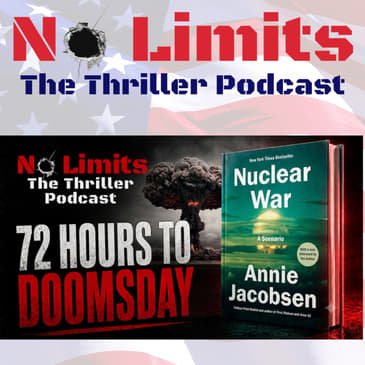
In this week’s episode of No Limits: The Thriller Podcast, Chris and Mike go nuclear as they break down Annie Jacobsen’s terrifying nonfiction book, Nuclear War: A Scenario.
Join us as we step inside the war room to examine the harrowing 72-minute timeline from an initial missile launch to global obliteration. Does Jacobsen successfully blend deeply researched journalism with the pacing of a thriller—or does the book struggle to decide what it wants to be?
Topics we cover:
The reality of “launch-on-warning” policies—and how split-second decisions could doom the planet
Missile defense systems, the illusion of control, and whether anyone can truly stop an incoming attack
The long-term consequences of an EMP attack on modern infrastructure
Why surviving the initial blast could be worse than dying in it
Whether Nuclear War is the ultimate cautionary tale or a bleak exercise in determinism
—
🔗 WATCH, LISTEN, & FOLLOW US:
Website → https://thrillerpod.com
YouTube → https://thrillerpod.com/youtube
Spotify → https://thrillerpod.com/spotify
Apple Podcasts → https://www.thrillerpod.com/apple
Instagram → https://thrillerpod.com/instagram
Twitter/X → https://thrillerpod.com/twitter
Facebook → https://thrillerpod.com/facebook
💬 JOIN OUR BOOK CLUB
Die-hard thriller fan? Join our Book Club on Patreon for exclusive discussions, behind-the-scenes insights, and 24/7 thriller conversation:
👉 https://thrillerpod.com/bookclub
📚 ABOUT NO LIMITS:
• The Mitch Rapp Podcast: Deep dives into Vince Flynn & Kyle Mills' Mitch Rapp series.
• The Scot Harvath Podcast: Exploring Brad Thor's high-octane Scot Harvath universe.
• The Thriller Podcast: Book reviews across the thriller genre: Jack Carr, Dan Brown, and more!
—
#AnnieJacobsen #NuclearWar #ThrillerPod #ThrillerBookReview
[00:00:00] You're there one day and then you're liquefied the next. The living envy the dead. She had to say that quote twice. She did. Yeah. I'd rather just have died in the initial explosion. Hey guys, I'm Chris. And I'm Mike. And welcome back to this week's No Limits: The Thriller Podcast. Oh wait, the Thriller Podcast. How you doing tonight, Mike?
[00:00:30] Well, we're about to go nuclear on this one. Let's put it that way. Are we? Okay. No, great book. We've heard so much about Annie Jacobsen and her body of work. I didn't even know some of her earlier books. I didn't know she wrote all the things she wrote. So the more and more I hear about her, the more and more I just want to devour everything. And I thought nuclear war, a great place to start. But yeah, her most popular book,
[00:00:57] I think it's kind of put her on the map in some ways. And now following up with biological war, which hopefully we'll have our take on out for you in the next week or two. I mean, this was a perfect time to do it. She was just on Rogan. She was just in DC and on, you know, going on a book tour. So now that she's fresh off the release of biological war, let's go back and reread nuclear war here and see what we think. Yeah, let's do it.
[00:01:23] 2024, uh, titled nuclear war, a scenario. I wanted to kick this off with a little bit of a question. Is this journalism or is this a thriller or is it both? Ah, that is very near to the question I wanted to ask you, which is, does this book know what it wants to be? Does it want to be a journalistic expose into documents that either Annie Jacobson has
[00:01:52] seen or is it a what if scenario kind of like the Marvel universe, a what if, because you can't see all the documents, you can't get all the classified intel. And you quite frankly, nobody can predict how this war nuclear war would go down. So is it just a fantasy? Is it just projecting and predicting things out? But it's also seemingly based on research where she cites documentation, uh, papers that have been declassified conversations she's had with people and planners at the highest
[00:02:21] level. Yeah. Years. Yeah. Um, so similar to your question is does this book know what it wants to be and how well did she pull off it being a cautionary tale, but one that's fact and fiction at the same time? Yeah. That faction. Um, I don't know. I, so I, I like this book a lot. Let me just get that off my chest. I, I like this book a lot. I did find myself in the beginning struggling a little bit
[00:02:51] outside the fact that boom, we kick it off and we're fricking bombing Washington DC. And like, sure it, it is fricking bleak, man. This book is a, is a downer. Like I was just at a Nats game last Monday. And if I was at that Nats game, I would have been dead. Like, you know, like unless I'd been going to the bathroom and then I would have died of radiation poisoning, like we're all dead anyway. Hours. Yeah. But then we quickly pivot into like this sort of bridge between a bunch of research,
[00:03:20] compiling it, giving us backstory. Um, and then we don't quite get more into like the thriller side of this book until we begin to progress along, right? Until we begin to, because she jumps right to the explosion. Then she has to backtrack to like, all right, explaining how it would get launched and then having to give us all this history and back and forth. So that while I guess, I guess I wasn't quite ready for that. I just didn't know. I didn't know what this book was. Everyone has just told me
[00:03:49] like, Oh, it's nuclear war. It's a scenario. I just thought it was going to be a thriller about a nuclear war. Like, and, and, and, but this is more so it's a war games, uh, documentation. Essentially. That's what it is. It is like, if this is what let's just say, all right, this is what happens. This is how it's going to happen based on all the research I did. This is what I know would
[00:04:15] happen if this were to happen. Like, you know, like it is just a, what if this happens and then this is how everyone would react. And I think the take home is it's fucking scary and it's, and it's fucking depressing, you know? And then this idea of sure. Like I was constantly thinking the entire time, like deterrence has to work. Like it was no other option. Who, who, who would be a madman to
[00:04:45] release in, I had no idea we have this whole strike on, you know, or launch on warning, on warning, like policy, no idea that existed. Like a lot of tidbits, uh, throughout that I was super intrigued about learning about, but yeah, it's, it's a different idea. And now I'm maybe like, now that I'm, I know what I'm getting into with biological war, I'll ride with that one a little bit differently, but yeah, no, I'm interested to see like, what, what, what do you think this novel
[00:05:14] is? Do you, do you think it knows what it wants to be? It's interesting. No, you're posing the right questions where I think we're, we're asking the right questions, but it's so funny. We're coming at it from way different viewpoints. I did not at all go into this thinking it was a thriller. I knew it was nonfiction and looking back the subtitle, a scenario very much helps me kind of, uh, around some of my
[00:05:39] critiques and concerns about the book because that clearly shows Jacobson saying, I am going to present to you a scenario thoroughly researched, thoroughly based on years of conversations, documentation that's available, uh, of how this could play out. And so I don't think she misses on, uh, the very real prop probability of some of these individual events happening as she describes. My issue though, kind
[00:06:07] of is on that approach of as a reader, I'm glad she committed to that. So it helps me understand and digest the book better and maybe enjoy the book better. As a reader, it's not exactly what I would ideally have been looking for in a nuclear war scenario book, because at times when she mentioned certain classified documents and what they say and what the protocols and policies are,
[00:06:33] lean into your context. I would have wanted to hear like a true nonfiction story. You know, Jack Carr did it with targeted Beirut and, uh, so many others, you know, that I've read, you know, you're John Meacham's of the world. I really wanted to like, give us the interviews, give us the primary source material, quote it, give us the, you know, the facts of the matter of who would do what, how would the process play out? Yet instead it's this half fictional, like it is fiction of like
[00:06:59] this person would then wake up and call this person. They'd be on a car ride to get to this building. And while they're there, they place this call. If it's fiction kind of lean into that and add the drama of that happening. I was kind of caught in the middle with the drama of when, when the movers and shakers were doing and making the decisions that they were making in the moment. I wasn't that bought in. Cause I'm like, this isn't based on history. It hasn't happened. Is this a policy? Is it not? And I wasn't bought in because I care about them deeply as a character
[00:07:29] who's been sold to me. It's just a title, you know, the title of this person would do this thing. I want an interview like in her author's note at the end. I really loved how she said, I talked to this person. Here's what position they were in, in the government. I talked to this person. I spent years interviewing, getting to know this person. This is their opinion on it. If that was woven into the text more like a traditional nonfiction book might do, or even
[00:07:53] a podcast, right? A long form podcast series on something like this. I feel like those media formats would have worked better for me than this quasi nonfiction, quasi fantasy fictional scenario. So the word scenario indicates to me, that's what she wanted to pull off and pulled it off very well. From the reader's perspective, I was caught between two worlds. The other thing of it is I wouldn't
[00:08:18] have minded scenarios. I was almost disappointed in how limited my critical thinking was in just having to go along with, oh, this is the one way it's happening. I would have liked to consider what if the Russian DC or Kremlin White House phone worked and somebody picked it up on the other end? I didn't want to have to straight jump to one, or I would have liked to play with one North Korea
[00:08:46] nuke hits DC. What might restraint look like by our politicians? And that might be the end of their career. That might be not feasible. But I didn't want us to have to so easily go from North Korea launches one nuke or two, I guess, with the California stuff. And then all of a sudden, there's 100 however many flying and then Russia automatically attacks and we automatically attack back and then the launch on command go. Maybe that's realistic because the documentation,
[00:09:13] the policies say that is what would happen. But I would have liked a few more other scenarios of what could have happened. What could restraint kind of half quasi looked like even if it's not realistic. I just didn't like the fact that we all of a sudden went to Russia's now launching however many nukes automatically. That just upped the ante too much to me where I was like, I think there's got to be some in between here just because they saw them on radar flying over their territory. But I
[00:09:42] guess that's the question. As the system is currently set up, would that have a snapback reaction to let's launch them? Yeah, I think really you have to think about like, all right, what is the true villain of this? And it's not so much, I mean, yeah, it is the nuclear weapons, but it's also the time and the lack of time there is.
[00:10:07] And the idea of, yeah, like she explains this over the course of however many pages as books is, but I'm pretty sure it would take long. It takes longer for you to read this book than an actual, you know, I think in total, we're at maybe 70 minutes of before from initial launch, initial launch to essentially the entire world being obliterated. And that's unfathomable to think about in actuality
[00:10:36] that 5 billion people will die immediately for nothing, like, and have nothing to do with it. And those that do happen to ride it out in a nuclear bunker or somewhere on an island, like whatever, like, what will they even have? You know, it does, it causes you to make like a lot of
[00:11:00] these thought provoking ideas, like, holy shit, like, this is scary. Like, this is truly scary. Yeah, completely. But I will agree with you that there's times where I would have preferred either leaning into one or the other, you know, like, there's one point where she tries to lean more into this scenarios type thing
[00:11:23] with when the Secretary of Defense has like a, you know, crisis moment or moment of conscious moment, like, wait, we don't have to like launch all these things. And then, you know, everyone's like, no, we do like, we literally have use them or lose them type mentality. Yeah. Um, and maybe it's just supposed to be this thought provoking exercise of like, these are the policies we have
[00:11:51] putting into like the paranoia of it all, the lack of time, you know, like everyone's making this split decision. You don't know that. And bringing in the idea that the Russian, all the Russian technology is actually not as good as our technology. So they would, they would see these, what is it? Five nukes and it would look like a thousand to them. And like, so I don't know. It's just, it's an interesting
[00:12:15] thought provoking experience, but I, I a hundred percent agree with you. Sometimes it doesn't do the, it needs to lean one or the other way and it tries to have both its cake and eat it too. Yeah. I think it's a fair way to put it to give her the do though. It's like she very clearly wanted to tell the story this way and executed it perfectly. Um, it, it got at the themes of right. The system is designed to fail. The president has
[00:12:43] sole authority launch on warning. Like it's just pushing our leadership towards catastrophe with no other options. Also this kind of the fog of war or this illusion of like control that like everybody who has the potential to put their finger on a trigger has built in mechanisms to prevent them from doing so. Well, not really. You can't turn these things around. The command structure is set
[00:13:09] up to, if it's a go, it's a go. Uh, once the things are in the air, right? That's another angle is I think where it works best. Like you said, as a journalism, perhaps what was most intriguing to me about the book was not how everybody dies and how the nuclear goes down, but it's how woefully unprepared we are when we think with the defense spending that we have to me, my first reaction, as most Americans would probably say when we hear Pyongyang launch a nuke, Oh, shoot it down.
[00:13:36] But right. Like, but in fact, each one of those missiles, well, first of all, we only have 40 of them to potentially shoot it down. Each one only has maybe a 52% chance of hitting its target. If we're that lucky. Yeah. If we're that lucky, like most of the tests that were like sub 40%. Yeah. That is insane. We're spending billions of dollars. Like I want some lasers, man. Dude. And that's on older tech.
[00:14:02] Yeah. I want some like death star type shit to be able to shoot anything I want out of the sky. I want satellite shit. I want like an iron dome of satellites in outer space that just immediately detect this thing, lock onto it. It's game over. You kill it a hundred percent, you know, completion. So I think I want a little more of that journalism, like you said, in that when she's exposing that and like showing us there's this illusion of control or this illusion of like
[00:14:28] my naivete of just shoot it down. I really liked that. She's exposing that doesn't exist. And you're misinformed if you think it exists and you, you know, you've been hoodwinked. If you think that's where our defense spending has been going in, our research has been going, that's not where billions and trillions of tax dollars for decades have gone. Maybe it should, but that's not what happened here. So I think the book, it, it, it, it ends up being a warning. It's a cautionary tale.
[00:14:57] But I think I want a little bit more of an analysis of where our current systems are at. And instead we just got like, let me just show you this one fail point. And like, once that fails, how everything goes down, that's not really an objective analysis of the system that's in place. Like I said, the movers and shakers who run it. Also, I could have used a little more of the geopolitics of it all. I feel like North Korea and Russia almost became cartoonish in that they,
[00:15:25] they're just nuke throwers. Like to me, they were just in a video game, just like tossing bombs at us. I think it was, it was the, the layers were peeled back toward in the end when we heard about North Korea's bunkers and a little bit about their propaganda system and how the citizens, you know, are so misled to think, you know, Kim Jong-un's a God and all this. I just wanted a little bit more of who the North Koreans are, how they're acting. We didn't get into any of their cyber espionage stuff.
[00:15:52] I think cyber also, how big a role that plays in all of this. Nuclear secrets being stolen. Yeah. I don't know. I just want a little bit more of the geopolitical connections. Like as far as it went with the Russians is they didn't pick up the phone. Like I just want a little bit more of like, what realistically do back channels look like besides like the sec def or the secretary of state just screaming, no one's answering at the Kremlin. Like no one's answering at the Kremlin.
[00:16:21] No one's answering. Oh, I guess nuclear war and Holocaust has to happen now because no one's answering. Maybe that's true. Maybe again, I'm naive to think the cold war, like red telephone on the desk is like actually just a decoy. It's not real. But again, I thought that could have been analyzed more. And I was disappointed. The book was not about being an analysis. It was about being what it's called one scenario. Hmm. Yeah. I do think it, it does bring up this idea of like the psychology of, of leadership.
[00:16:50] Sure. Would you like, you know, it, it puts a lot of, a lot of this onus is not on mechanistic. It's, it's, it's all on like the human decision makers, the president, like the idea of, you know, this, in this scenario, the president of Russia is so offended and so distrustful of the United States to wonder why the president hasn't called him that it must be a, you know,
[00:17:17] a, an attack on them when instead thinking, wait, this guy just had a nuclear bomb. Like, and he didn't call me like, you know, maybe he had other shit to do. Maybe he died like right away, you know, like not to like pause, like no one's going to pause. No one's going to pause. Yeah. And I think it comes, like one of the big, you can't pause. Like is this idea of the launch on warning debate? Like should any country have this policy? Is that okay?
[00:17:46] Oh, I think like you said, deterrence has to work. So you have to say that's your policy. Here's another limitation, right? So yes, we can get into that to debate, but what we're debating is, is not the facts on the ground. It's debating what is generally known. So it's an, it's another point where there were a few moments where I went, the text really should have an asterisk that says as far as I know, right? As far as the public knows.
[00:18:11] Again, you can't really tell this story in, in, in full, you know, omniscient, uh, understanding everything everywhere. So there were a few moments where I was like, this story just actually can't satisfy as much as I want it to. My expectations are just off because I want to know launch on warning. Do we just say that as part of deterrence? Or is that the real protocol? Are there even protocols? Like she started getting at it with
[00:18:38] the nuclear football. Like I felt like that was the most true, accurate nonfiction we got of like, what's the history of the football? What's inside it? How do the cards work? Who has the cards? Who gives the cards to who, who says what codes to who? So it was like a lot of that, like policy and procedure that is probably accurate and real and verified. I love digging into a lot of the other policy stuff is just this kind of hidden. This document said this and it was declassified.
[00:19:03] So this must be the official policy or we can't shoot down nukes so far as we know, you know, I just kept coming back to this as far as we know. I think you're bringing up something that I saw online and that a lot of critics of this were saying that it feels very deterministic. Yes. That it puts it as though this is unavoidable no matter what, in that a lot of like what I was reading online is that a lot of experts argue that there are opportunities for restraint.
[00:19:33] And this book suggests that, that no one is ever going to restrain and, but maybe by putting that caveat, a scenario, not the scenario, like, you know, you could get around that, but yeah. Is it also her point though, that we're closer than you'd think that. Yeah, no, I think it is like what we're criticizing is actually what's going to go down. Yeah. And one of the things like I wanted to bring up is like, are you hopeful at the end of
[00:20:01] reading this book? Like, what did you feel after reading this book? Were you more informed? Were you more anxious? Like, did you feel happy, sad? Like, you know, that's the problem. It was like a little bit of each. Yeah. When I went into the book expecting a whole lot of one, I thought it was a whole lot of despair, a whole lot of, oh shit, I'm cooked. This is over. Humanity's done for. And I don't think I went that far. Maybe it hit in the end when
[00:20:29] we're looking at, what was it? 24,000, 26,000 years into the future. To me, that's the only part it really hit on this deep existential cord of is our lifespan, our children's, grandchildren's, great-grandchildren's lifespan, the period at which the fall of humankind, whatever that means,
[00:20:57] begins. Like, is this a turning point? Is the nuclear era, right? Living in a world post-1940, whatever, is that the turning point in humankind's existence? And that made me think a little. The whole everything's going to blow up. I'm so scared about nuclear radiation because someone's going to, I'm going to be at a baseball game and all of a sudden this is going to happen. I'm going to get fried. That to me, I just kind of read that stuff and was like, yeah, yeah, yeah. Okay.
[00:21:22] Like, it's all going to happen. Some of the ecological impacts, I think, resonated. The long-term historical is humanity going to be done for? Comparing it to the dinosaurs, right? Yeah. Of an asteroid event just did it to them, right? Like, would dinosaurs have become fully conscious and had a superintelligence and built AI and built, you know, machines and megacities? Would
[00:21:47] they have done that if it were for an asteroid? A lot of those things made me think, but I would say it didn't go as far as I was almost hoping it would on that hope and despair debate. Yeah. To me, it, of course, it's like scary and like, it's, you know, I'm very like freaked out. Like just when you start thinking about like, if, if this were to happen, but to me,
[00:22:13] like I already, I already knew all that stuff, you know, I've seen enough television, enough, read enough novels where this happens that that's why this thing is like such a big, bad, scary thing to me. The things that were more scary to me is not so much the bomb. It's the lack of, like you said, the lack of unpreparedness we have, the lack of, the lack of time that we have when these situations are put in case. Like you, you couldn't have a Jack Bauer, you know,
[00:22:43] 24 hours to, to hunt down and find this, like, you know, like it's, it we're on the scale of seconds and milliseconds. Um, you know, the idea of the launch on warning, just the different policies that we might have, like that was more scary to me. That was the scarier thing to me than the actual nuclear weapons itself. And because of that, I would have liked this written as a nonfiction historical analysis of let's, let's talk to the people who've been in those chairs.
[00:23:13] Let's get their thoughts on it, whether they're retired or still active, get as close to the still active ones as we can. Um, it's just more interviews, more, you know, personal exchanges back and forth, different beliefs, philosophies, possible policy changes, somebody in Congress, right? On a nuclear commission, somebody at the IAEE, the atomic energy, whatever it is, agency. Um, I wanted to talk to the people who've been close to this thing instead of just living in a fantasy world of it could happen like this. This is what's going to happen. This is how it is.
[00:23:43] Maybe that's her point, but I just would have liked more of other perspectives, but I think point a part of her point is we don't have time for people's perspectives. We don't have time for policy changes. The cat's out of the bag. The nukes are on the loose, right? Like, um, maybe, maybe that's the point that this terrifying reality isn't going to be a series of choices and policy proposals, but it's going to be a knee jerk chain reaction. That's
[00:24:08] inevitable. If that's the question you're posing, then sure, that's something that can be explored and it is explored. Um, I just want a little bit more of the, what are the series of choices? Who would make them? What are the different ways that you can make them and what might we actually do? The other thing is I did like the tech explanation of how, you know, a submarine nuke is very different from, um, uh, an airborne launched one or a B2 bomber. And then also the
[00:24:36] Merv system and some of the technology, right? The Merv clustering. Um, I thought all of that was done really well. And that almost had that level of analysis that I'm, I'm referencing or looking for. But another part of that's missing is for me, what's more scary is not the nukes thrown for conventional warfare with, with another nation state. I feel like we kind of, I don't know about you, but like, to me, it's just like a dude carrying a fucking suitcase, you know, just put
[00:25:04] something on a truck and nobody knows and just drive somewhere. Like we learned a lot about the military side of it all, but you know how technology just think about like the transistor and microchips and everything. It's like, it's not just shrinking and getting smaller, right? We're doing that on a, um, exponential curve, right? Like we're now putting trillions of transistors on a microchip that's used to be the, you know, in the seventies, that was the size
[00:25:30] of an entire room. And now that computer is the size of a nanometer or whatever. Well, what happens when nuclear technology kind of reaches that, that phase, right? Of when you can pack it in a suitcase, you can load it on a truck. You can have it in a, a backpack, like that kind of stuff makes me more scared than is Russia going to push the button to automatically launch 50 nukes at us because they saw something on a radar. Maybe that's what I should be concerned about, but frankly, I'm not,
[00:25:56] I'm more concerned about some bad actor sneaking one into a city somewhere and going boom. I also thought the, the EMP of it all was a lot more compelling to me because like that I could see that that's more, even though it probably has equally the amount of devastation on the world. It's just, it's not as immediate as a multiple nuclear attack. Um, but to me, like there's the idea of taking out
[00:26:26] with one fell swoop, all of our electronics and to the idea of everything that goes into from the dams to, you know, all of our cars now, like, well, not only like my electric car, but your regular car, right? A regular car. Like they're all even like the airplanes, right? Like fly by wire. Like there's only a, only the doomsday planes were the ones that actually have a real yoke
[00:26:51] to actually be able to fly them. Like it wouldn't be able to do that. The wastewater, like, you know, mixing of chemicals, like my production facility where we make our things, like all that would start like going freezing. The oxygen in my lab would, would all it's controlled by electricity. Yeah. Um, that is like, I don't know. I don't know why it's scarier than me than the idea of, of an immediate boom, nuke, you're dead. I guess like, cause that's more instant than the site,
[00:27:19] the idea of the longterm. We're going to have, uh, so those, the people are going to survive and then have to figure out how to survive. And there's going to be, you know, tyranny and lawlessness death, like in, in that way, which is much more gruesome than, than just, uh, you're, you're with air one day and then you're liquefied the next. Yeah. The living envy, the dead. She had to say that quote twice. She did. Yeah. That made a point of it. The first time I heard it, I was like,
[00:27:49] I really, but you're alive. Maybe there's hope. And the second time she dropped it, I was like, oh, she's right. I'd rather just have died in the initial explosion. You know, like, yeah. When that, when that was repeated, that meant something. Yeah. Yeah. The EMP stuff, which is interesting because I think you're right. Putting a nuke in a satellite at low
[00:28:16] water. No, you're, yeah, exactly. Never thought about that. Like that is crazy. Like that's a scenario I would actually want to read about. And so having it here was almost like tacked on the same way we went from North Korea launches, the nuke does the thing in California off the submarine. Okay. And then we're launching nukes and then Russia's launching nukes and it's just back and forth and back and forth. It was just, okay. Add on the EMP and then the EMP goes off and then there's nuclear winter and the, and you know, nuclear winter warms the planet, cools the planet.
[00:28:42] And then there's a nice age and then everyone dies. Like I almost want each of those to be an analysis on its own. Like each of those to be a chapter in like some great study that's going to analyze each one of those. It just was like, let's just pile it on. Even the second nuke in California I didn't need. I was like the, the new, the DC one, that's going to be enough. So it's just things kept escalating to tack them on, which felt like a, let's just tack it on for fun.
[00:29:07] I wanted to ask you about that. And is it because do you think you, I also felt that too, that like, wow, why, but we just read a book not too long ago that delved into this idea of not if a nuke hit a nuclear reactor, but you know, what if an airplane worst case scenario, what if an airplane hit a nuclear reactor? And like, she does bring it up this idea of, you know, it's, if you are going to unleash a nuke, it's like sort of an unwritten rule that
[00:29:35] you don't go after nuclear facilities. I'm, I would argue that if you're willing to use a nuke, you're probably willing to use it anywhere. But she made that, she made that point, right? Like the conventional wisdom. And sadly, some of the policymakers have, you know, it's written by the Geneva conventions. Right, right. Exactly. It's like we abide by the Geneva conventions. So when we write our nuclear response plan, we are going to imagine a scenario by which we want to protect the rights of individuals.
[00:30:02] It threw the baby out with the bathwater, like all that, that's gone. We are way beyond that. So I think she actually made that point of the people who are doing this. And once this, once this chain reaction happens, mad king, that world doesn't exist anymore. That paradigm does not exist anymore. You can't operate within it. So our policymakers would design a launch on warning thing, which is, you know, we automatically strike and the people attacking us, we would understand are going to go for the jugular because if they're attacking us, they're going to go for the jugular,
[00:30:32] right? They're going to maximum amount of carnage and nuclear reactors could be that. I'm glad you bring up the worst case scenario, the TJ Newman series. The brilliance of those are that they're pure fiction, but the brilliance of those are that they make you imagine what if this was real? And you do that because you commit to, I'm telling a fake fictional story, but within the boundaries of what you're familiar with, airplane crashes and nuclear meltdowns.
[00:31:00] Boom. I could tell a fictional story and put together two things you're intimately familiar with, but that you never considered going together. Whereas here, it's just instead of telling a fictional story and putting it all together, it's just let's just pile it on. Like I did research on what would happen in an EMP attack. So while nuclear Armageddon is going on, I'm going to have an, I'm going to have an EMP attack or, you know, sarin deck at the end. Yeah. I need to have a chemical attack. Like, let's just, I've, I've done research about North Korea and these bunkers they've built.
[00:31:29] So let's go there. I just don't know if it was almost the easy route to say, I'm going to pack everything in. You're like making a turduck in here. Um, and sometimes you might just need a really well done Turkey with a couple of sides around it. It would have been interesting if you set this as a fictional novel in North Korea, like where you spend most of the time in North Korea and you sit with like the villain is, you know, Kim Jong-un type of Supreme leader character. And he decides to,
[00:31:59] you know, make that plunge, pull the trigger. And then you're with him the entire time. And, you know, that would have been an interesting take of like how this works. So I brought this up to you and maybe we could do it next time if we have time. But so Catherine Bigelow wanted to adapt this book into a movie and some other companies, some other studio acquired the rights right away and she, she couldn't do it. So, but she was ultimately able to tell a similar story that came out on Netflix.
[00:32:28] I believe it was last year and it's called House of Dynamite. So I almost want to go watch that because I feel like basically what I've known about that movie is that it's essentially this, but purely as a fictional story. Like we're just, you know, so I would love to juxtapose after reading this and then watching that and see like, all right, do I actually prefer it just being a fictional story and me seeing like how the emotionality of people like break down and stuff
[00:32:56] like that. So maybe we can do that next time. Great pull. I definitely want to see that movie. I've meant to, to watch it and this is a perfect time, especially to compare it to this book. I do think an overlap here and a point of praise for this book. I definitely liked the minute by minute or even second by second breakdown that perhaps to me was one of the more intriguing
[00:33:18] things because it also seemed based in reality. Like I do want to know at what point who detects what, right? Like when do we detect the launch? But then I equally want to know what is our current command structure for that detection to be evaluated, recognized and passed along? Who does it go to? And does that person have the opportunity to say, let's not pass this to the president. It might be
[00:33:46] fake. Go look at it again. Do they kick the football back? And by that time it's too late. I really liked being like inside the war room, which I think in the movie, right? A lot of it from the trailer takes place inside the war room. They're watching on screens. They're analyzing the data, seeing what decisions need to be made. I really liked how Annie Jacobson timestamped everything within that 72 minute escalation. The timestamping to me was something I wanted more
[00:34:15] of and I thought was really handled well. And if you do it in nonfiction or fiction, I feel like that's something you keep either way. You still do it. Yeah. 24 style Jack Bauer countdown. So I wanted to ask you, like, I almost feel like we can't quite give this a scorecard because it is. And I don't think we gave, uh, like targeted Beirut, uh, a scorecard. I don't think so. And we have, we have a new, uh, targeted series coming out
[00:34:41] Lockerbie. We already knew it was coming out, but it's, it's official. Yeah. Uh, the plane, uh, over Lockerbie, uh, Scotland. Um, I don't know. You want to just say like, give it a letter score? I think a letter score. Yeah. Yeah. Yeah. I think it's a solid B plus for me. Yeah. B plus A minus. Yeah. I think I expected to be in that territory,
[00:35:05] that A minus territory. I think I enjoyed reading it, but the fact that I keep coming back to it, it's not exactly what I wanted in a story that tells me how nuclear war would go down. Um, it was a, it was a single story, which was a deliberate choice. So just, I, I think I could see people take me as an A minus B plus for me, as I'm reading it, it just, it just a few times wasn't hitting the,
[00:35:30] the cords that I wanted to hit. So I'm going to go B minus. B minus. Okay. Yeah. I'm gonna go B minus. Are you bought in enough that you want to read biological war? A hundred percent. Um, I'm extremely interested. Uh, the things I liked in this book to read for alternate scenarios would be a lot of fun. Uh, how a biological attack could happen. If it does happen that way, what would the countdown look like? Who are the policymakers who makes the decisions? What
[00:35:58] decisions can they make? Yeah. Because I, I have a sense that that book is going to be a way, the timescale on that is, is much longer than this. It's gotta be slower, right? Oh yeah. Much slower. Yeah. But maybe not. I don't know. We'll see. It's also one where I don't mind it being told one way. I feel like however that attack happens will be so similar to how many other biological attacks would happen where, where nukes is just like, there's almost too many scenarios. I feel
[00:36:26] like a biological thing, she's probably going to get creative in some ways that it spreads, some ways it's designed, some ways it's been gain of function researched in a lab. Um, it's not a COVID, it's not a lab leak. It's just remind everybody that it's not a lab leak. Well, it's not gain of function that I'll, I did start the book and then this is the very first, so I'm spoiling it a little bit, but this is in the very like first chapter where like we are, while we're, we're not allowed to do gain of function research, we are allowed to do gain of
[00:36:56] function research if it's for the sole purpose of defense. So we're allowed to create something that gains a function and then use that as our mode of studying how to defend against it. You know what I'm saying? Like we create, we create, we have to create the nuke to, in order to understand how to stop the nuke. You know what I mean? Sure. Yeah. Yeah. It's all for, that's how we're, can only do it if we're going to use it for defensive purposes only. Yeah. Okay.
[00:37:25] That's how that, that, no, I'm just saying that's how we get around it. No, I hear you. I hear you. I also wonder if there could be a natural, just evolutionary something, right? Yeah. To me, like one of the greatest examples of this is the movie Contagion, um, to give you a breakdown of how, uh, I made the mistake of watching that like week one of, of COVID and like
[00:37:54] freaking out and thinking like, Oh shit, like, you know, this is what's actually going to happen. Yeah. Yeah. Uh, but yeah, in that case, it truly is a bat that eats something and it goes to a wet market and like, you know, just to see like in that, in that case, there's no man may, you know, no, no man had a hand in it. It's purely a, a system that just happens to arise. And is that what that is? That is scary. Was that a natural, just, I don't know what kind of science we were
[00:38:21] doing back then. I assume it was just a bad disease. Same with the black plague and the, exactly, exactly, exactly. And that's all because of one ship, like one ship came in and yeah, well, that's, that's, well, there's the crux, right? Of let's say this is going to be a natural phenomenon that develops because nature needs to develop a mechanism like that limiting populations. Like that's a natural thing for nature to have to do, right? Habitats, biodiversity, et cetera.
[00:38:51] But then you put on top of that human systems. So even six, 700 years ago, whatever it was, black plague, maybe that happened and rats were carrying it naturally, but it's not natural that there were intercontinental ships that could make it and dock somewhere and have human laborers offload it and then live in urban areas that are mega conglomerates of people who are for the first time in history living in such concentrations, you know, London, you know, of the middle ages and
[00:39:20] other cities. So yeah, it's like human systems will always exacerbate something. Is it ever possible that nature was going to do a mass extinction event anyway on its own as its own corrective mechanism? Probably not. It's always going to evolve. Humans have done something, even if it's just unintended consequence, right? Of we built ships. No one was ever like, let's build ships so nature can sneak rats onto it that can mass exterminate people in Europe. Like that wasn't
[00:39:49] the point between Asia and Europe, but it ended up happening because we had sea travel. Like there's always this interplay evolution and human systems. I can't tell you what, at what point one starts and one ends. Yeah. I would argue that there earth fights back, like, you know, wildfires, even though wildfires are started by, you could be started by, you know, uh, electric company that's not, you know, properly doing their stuff. Like
[00:40:18] it's earth is going to do it, you know, they, yeah. Yeah. Um, for a good reason too. One could argue. There may be a reason that like all the, it was main majority elderly people that died from COVID. Like, you know, it's, it's cutting off that at the ends, right? You, you typically that's, that's where you're going to the easiest meat that you can cut when you're getting to that saturation point of, uh, we can't just keep growing exponentially. Like we will run out of resources
[00:40:45] and the earth is going to fight back against it. I don't know where it is. I wanted to check. I got Fauci's diary here somewhere. Ah, his pink diary. Oh yeah. All right. I must've misplaced. I think it's inside the house, but I'll check that and get back to you. We'll have, we'll have a lot of Fauci talk, uh, in the next pod, but yeah, no, this is good. And this is, it's a nice change of pace. Uh, it was to read these two books and, um, I'm excited to talk biological horror with you. Sure. Same here. Absolutely. I'm excited to see
[00:41:10] what the topic of the third one will be. Yeah, no, for sure. All right. Well, before we get out of here, I need to thank our patrons, our deputy director, Sherry F, Brad E, Crowley C, Michael M, our special agents, Adam, Mike, Ben, Daryl, George, Matt, Don, and Chris, please subscribe to all three seasons of no limits. Check us out on our newly revamped, uh, website, ThrillerPod.com. Uh, and as always just let nuclear war be nuclear war.